-
5 September 2025
Speaker: Jie Ren, Howard University.
Title: Wall-crossing structures in Donaldson-Thomas theory (slides)
Click to read the Abstract.
The notion of wall-crossing structure (a.k.a. scattering diagram) was motivated by Mirror Symmetry and Donaldson-Thomas invariants, and also has applications in some other situations. The counting problems of certain objects in the relevant categories are encoded in such structures. I will introduce some basics of wall-crossing structures, and examples coming from algebra and geometry.
-
12 September 2025
Speaker: Qi Wang, Howard University.
Title: When Math Meets Markets: Stochastic Volatility and Derivatives Pricing
Click to read the Abstract.
Financial markets are awash with data and uncertainty, making them a natural playground for mathematics, statistics, and data science. While forecasting market movements is valuable, its true impact lies in applying those forecasts to the pricing of derivatives such as futures and options -- key instruments in investment and risk management.
This talk will begin with the basics of financial derivatives and classical pricing methods, including the Black-Scholes PDE, binomial trees, and Monte Carlo simulation, before moving to modern stochastic volatility models and their data-driven extensions. I will then present a semi-analytical framework that blends continuous and discrete approaches and bridges affine with non-affine models, combining data-driven insights with mathematical analysis to achieve efficient and realistic derivatives pricing. More broadly, the talk highlights how mathematics and data science help make sense of complex systems -- extracting structure from noisy data and building models that balance realism, tractability, and practical relevance in finance and beyond.
-
19 September 2025

Speaker: Minh-Tam Quang Trinh, Howard University.
Title: Zeta functions as knot invariants (slides)
Click to read the Abstract.
The Riemann Hypothesis, describing the zeros of Riemann's zeta function in the complex plane, is one of the Clay Foundation's six unsolved Millennium Problems.
In 1974, Pierre Deligne proved a remarkable analogue of the hypothesis, involving an analogue of the zeta function depending on a smooth algebraic variety. When the variety develops singularities, the hypothesis can fail. But in the case of singular plane curves, the zeta function shows a separate, surprising connection to knot polynomials. I will describe some recently-published work on this connection, joint with Oscar Kivinen. If there is time, I will also discuss an entirely different "Riemann Hypothesis" for these functions, proposed in 2018 by Ivan Cherednik.
-
26 September 2025
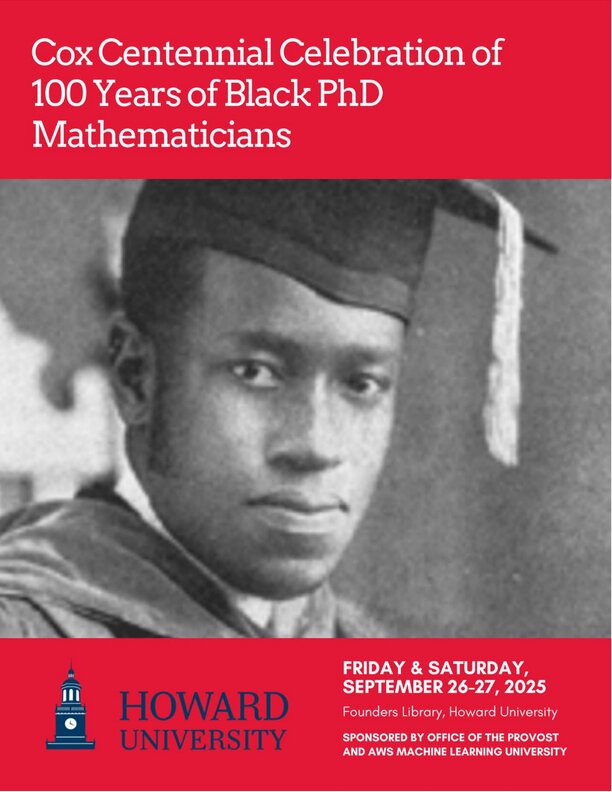
Cox Centennial Celebration
-
3 October 2025

Speaker: Ahmet Yildirim, (Ege University and Howard University).
Title: The Role of Differential Equation Modeling in Analyzing Vaccination Strategies and Waning Immunity During Epidemics
Click to read the Abstract.
sion of infection and recovery, the SIV extension incorporates vaccination as an additional compartment, allowing researchers to assess both immediate and long-term impacts of immunization. Moreover, the inclusion of waning immunity within these models reflects the realistic scenario in which vaccinated or recovered individuals may gradually lose protection and return to susceptibility. By integrating these dynamics into systems of differential equations, it becomes possible to evaluate the effectiveness of constant and time-dependent vaccination strategies, explore threshold conditions such as the basic reproduction number, and predict the potential for disease resurgence. Such analytical approaches not only deepen theoretical understanding but also provide actionable insights for policymakers seeking to design robust and sustainable epidemic control measures.
-
10 October 2025
Speaker: Bourama Toni, Howard University.
Title: Real and p-Adic Equation of Motion of the Harmonic Oscillator. Comparing Archimedean and Non-Archimedean Dynamics
Click to read the Abstract.
This chat-like presentation, accessible to undergraduate students, discusses the Poincarè Harmonic Oscillator and its variants, fundamental models in dynamical systems for symmetry, stability, periodicity and quasi/almost-periodicity. From its general description by the second order ODE $\ddot x+\omega^2(t)x^2(t)=f(t)$ we explore respectively its Archimedean phase-space formulation in real continuous time, its Non-Archimedean (p-adic) and quantum formulation. The geometry of motion and phase-space topology transform from the real (continuous circular flows in $\mathbb R^2$) to the p-adic domain (ultrametric tiles in $Q^2_p$). Smooth sinusoidal solutions and elliptical orbits over the reals versus solutions in power series of p-adic trigonometric functions $\sin_p(\omega t)$ and $\cos_p(\omega t)$ on finite convergence disks representing locally constant, hierarchical and discretized motion in p-adic time.
-
17 October 2025

Speaker: Lizhen Lin, University of Maryland.
Title: Statistical Foundations of Deep Generative Models
Click to read the Abstract.
Generative AI has achieved remarkable performance in various application domains, prompting a parallel line of work devoted to understanding its theoretical foundations. This talk will focus on the statistical foundations of deep generative models, the backbone of generative AI. From a statistical perspective, deep generative models can be understood from a nonparametric distribution estimation point of view, where the underlying generator is parameterized by a deep neural network (DNN). This talk provides a theoretical underpinning of deep generative models from the lens of statistical theory. The perspective allows one to explain why deep generative models work exceptionally well in practice, especially in high-dimensional tasks, and why they can outperform classical nonparametric statistical and machine learning estimators. A key insight is that deep generative models have the ability to adapt to various intrinsic structures of the data, such as a lower-dimensional manifold structure with the convergence rates dependent on the intrinsic dimension of the data, thereby circumventing the curse of dimensionality.
-
24 October 2025
Homecoming week, no colloquium
-
31 October 2025
Halloween, no colloquium
-
7 November 2025

Speaker: Joseph Hogan, Brown University.
Title: Machine learning and AI in the real world: Improving HIV care in western Kenya
Click to read the Abstract.
Successful implementation of antiretroviral treatment programs in sub-Saharian Africa has transformed HIV and AIDS from an emerging global health catastrophe to a manageable chronic condition. Many care programs, such as AMPATH in western Kenya, have implemented electronic health records with point-of-care interface for visualizing patient records and entering data in real time. This has improved the ability of care providers to track outcomes and, where necessary, intervene to improve them.
In this talk we describe development and implementation of a Bayesian decision support module geared toward maximizing retention in care - a critically important component of the cascade. The project involves building and validating predictive models derived from an electronic health record system, embedding the models in the EHR back end to generate real-time predictions of missing a scheduled visit, and using the predictions to activate pre-visit outreach by clinic staff. Our model addresses several idiosyncrasies in the data, such as competing risks, discontinuous hazard functions, and missing predictors. We describe how to generate various types of insights, such as flagging patient-level features that explain risk classification and identifying optimal timing for the next appointment. We also show the implementation of the model at the point of care and describe our plans for evaluating the impact of the decision support process.
This is joint work with Arman Oganisian and Nick Lewis at Brown University, and Ann Mwangi at Moi University in Eldoret, Kenya.
-
14 November 2025

Speaker: Abba Gumel, University of Maryland.
Title: TBA
Click to read the Abstract.
TBA
-
21 November 2025

Speaker: Christian Zickert, University of Maryland.
Title: TBA
Click to read the Abstract.
TBA