Preface Preface
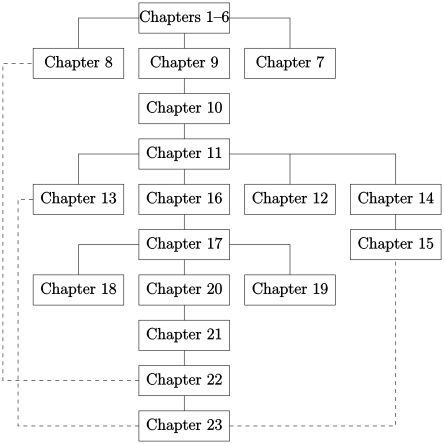
Bla bla bla + bla. (A broken line indicates a partial dependency.) See the [cross-reference to target(s) "complexAnalysisBook" missing or not unique] for more.
This real text has been used as the basis of a sample book for testing PreTeXt. So it is slowly migrating away from what the real book looks like and should not be construed as representative. For example, we have reduced the book to four chapters. Indeed, that previous sentence was more an excuse to test some cross-references with parts in the structural case, such as this one to DeMoivre's Theorem, .
Though there are no specific prerequisites for a course in abstract algebra, students who have had other higher-level courses in mathematics will generally be more prepared than those who have not, because they will possess a bit more mathematical sophistication. Occasionally, we shall assume some basic linear algebra; that is, we shall take for granted an elementary knowledge of matrices and determinants. This should present no great problem, since most students taking a course in abstract algebra have been introduced to matrices and determinants elsewhere in their career, if they have not already taken a sophomore or junior-level course in linear algebra.
Exercise sections are the heart of any mathematics text. An exercise set appears at the end of each chapter. The nature of the exercises ranges over several categories; computational, conceptual, and theoretical problems are included. A section presenting hints and solutions to many of the exercises appears at the end of the text. Often in the solutions a proof is only sketched, and it is up to the student to provide the details. The exercises range in difficulty from very easy to very challenging. Many of the more substantial problems require careful thought, so the student should not be discouraged if the solution is not forthcoming after a few minutes of work.
Roberto De LeoCagliari, Italy, 2021