
Section 6.2 Sobolev Spaces
Definition 6.2.1.
Let \(\Omega\) be an open subset of \(\bR^n\) (or, more generally, a manifold endowed with a Lebesgue class measure). Then, for \(p\in[1,\infty)\text{,}\) we set
\begin{equation*}
\|f\|_{W^{k,p}} = \sum_{|\alpha|\leq k}\|D^\alpha f\|_{L^p}
\end{equation*}
and
\begin{equation*}
C^\infty_{k,p} = \{f\in C^\infty(\Omega)\,:\,\|f\|_{W^{k,p}}<\infty\}.
\end{equation*}
The Sobolev space \(W^{k,p}(\Omega)\) is defined as
\begin{equation*}
W^{k,p}(\Omega)=\overline{C^\infty_{k,p}(\Omega)}^{W^{k,p}}.
\end{equation*}
We then set
\begin{equation*}
W^{k,\infty}(\Omega)=\{f\in W^{k,1}_{loc}(\Omega)\;:\;\|D^\alpha f\|_{L^\infty(\Omega)}<\infty\text{ for }|\alpha|\leq k\}.
\end{equation*}
Theorem 6.2.2.
Assume that the boundary of \(\Omega\) is smooth. Then
\begin{equation*}
W^{k,p}(\Omega)=\overline{C^\infty(\overline{\Omega})}^{W^{k,p}}.
\end{equation*}
In particular,
\begin{equation*}
W^{k,p}(\overline{\Omega})=W^{k,p}(\Omega)
\end{equation*}
\begin{equation*}
\overline{C^\infty(\Omega)}^{W^{1,\infty}} = C^1(\Omega).
\end{equation*}
Theorem 6.2.3.
Let \(\Omega\) be a bounded open set with smooth boundary. Then \(W^{k,\infty}(\Omega)\) is the set of all \(C^{k-1}\) functions whose derivative of order \(k-1\) is Lipschitz.Theorem 6.2.4.
For every \(k=0,1,\dots\text{,}\) the following holds:- \(W^{k,p}(\Omega)\) is Banach for \(p\in[1,\infty]\text{;}\)
- \(W^{k,p}(\Omega)\) is separable for \(p\in[1,\infty)\text{;}\)
- \(W^{k,p}(\Omega)\) is reflexive for \(p\in(1,\infty)\text{.}\)
Proof.
Theorem 6.2.5.
Suppose that \(u\in W^{1,p}(\Omega)\) has continuous weak first partial derivatives. Then \(u\in C^1(\Omega)\text{.}\)Proof.
\begin{equation*}
\lim_{h\to0}\|u_{\xi,h}-u\|_{L^p}\to0
\end{equation*}
Theorem 6.2.6.
Let \(p\in(1,\infty)\text{.}\) The \(u\in W^{1,p}(\bR^n)\) if and only if \(u\in L^p(\bR^n)\) and the function
\begin{equation*}
h\to\frac{\|u_{\xi,h}-u\|_{L^p}}{|h|}
\end{equation*}
is bounded for any \(\xi\in\bR^n\text{.}\)Definition 6.2.7.
\begin{equation*}
W^{k,p}_0(\Omega) = \overline{C_c^\infty(\Omega)}^{W^{k,p}}.
\end{equation*}
\begin{equation*}
C^1_0(\overline{\Omega}) = \{f\in C^1(\overline{\Omega})\;:\;f|_{\partial\Omega}=0\}
\end{equation*}
precisely because the only constant function in \(C^1_0(\overline{\Omega})\) is the zero function. One of the applications of the Poincare' inequality below is to extend this to \(W^{1,p}(\Omega)\text{.}\) Theorem 6.2.8. Poincare' Inequality.
Let \(\Omega\) be bounded in at least one direction. Without loss of generality this is the \(x_1\)-direction and \(|x_1|\leq d<\infty\text{.}\) Then there is a constant \(C>0\) such that for \(u\in H_0^1\) we have
\begin{equation*}
\|u\|_2 \leq C\|\nabla u\|_{(L^2)^n},
\end{equation*}
Where the index \((L^2)^n\) indicates that each component of the gradient \(\nabla u\) is an element of \(L^2(\Omega)\text{.}\)Proof.
\begin{align*}
\|u\|_2^2 \amp=\amp \int_\Omega|u(x)|^2 dx = -\int_\Omega x_1 \frac{\partial}{\partial x_1} |u(x)|^2 dx\\
\amp=\amp -\int_\Omega 2 x_1 u(x) \frac{\partial}{\partial x_1} u(x) dx\\
\amp\leq\amp 2 d \|u\|_2 \left\|\frac{\partial}{\partial x_1} u \right\|_2.
\end{align*}
Hence
\begin{equation*}
\|u\|_2 \leq 2 d \left\|\frac{\partial}{\partial x_1} u \right\|_2 \leq 2 d \|\nabla u\|_{(L^2)^n}.
\end{equation*}
Since \(H_0^k\) is the closure of \(C_c^\infty\) in the \(H^k\) norm, the same estimates apply to \(u\in H_0^k\text{.}\)
\begin{equation*}
\|Du \|_{L^p}^p \leq \|u\|_{W^{1,p}}^p = \|u\|_{L^p}^p +\|Du\|_{L^p}^p \leq (1+C)\|Du\|_{L^p}^p.
\end{equation*}
Hence \(\|Du\|_{L^p}\) and \(\|u\|_{W^{1,p}} \) are equivalent norms on \(W^{1,p}_0(\Omega)\text{.}\) We define
\begin{align*}
\|u\|_{W_0^{1,p}} \amp:=\amp \|Du\|_{L^p},\\
\|u\|_{W_0^{k,p}} \amp:=\amp \sum_{|\alpha|=k} \|D^\alpha u\|_{L^p},\\
(u,v)_{H_0^k} \amp:=\amp \sum_{|\alpha|=k} (D^\alpha u, D^\alpha v).
\end{align*}
Extensions. Given a \(f\in L^p(\Omega)\text{,}\) we can extend this function to a function \(\tilde f\in L^p(\bR^n)\) by simply setting \(\tilde f\) to zero outside of \(\Omega\text{.}\) As we already saw, non-trivial characteristic functions are not weakly differentiable, so extending functions \(f\in W^{k,p}(\Omega)\) for \(k\geq1\) is not a trivial matter. On the other side, functions in \(W^{k,p}_0(\Omega)\) can be extended just as we do in case of \(L^p\) functions. Next result shows that, if the boundary of \(\Omega\) is nice, functions can be extended. Lemma 6.2.9.
Let \(p\in[1,\infty]\) and assume that \(\Omega\) has smooth boundary. Then, for every bounded \(\Omega'\) such that \(\Omega\subset\Omega'\) there is an operator \(E\in\cB(W^{k,p}(\Omega),W^{k,p}_0(\Omega'))\) such that \(E(f)|_\Omega = f\text{.}\)Proof.
\begin{equation*}
\tilde{f}(r, \theta) =
\begin{cases}
f(r, \theta) \amp \text{if } r \le 1 \\
f(2-r, \theta) \amp \text{if } 1 < r < 2
\end{cases}
\end{equation*}
It is easy to verify that \(\tilde f\in W^{1,p}(\Omega')\text{.}\) Indeed, for \(r' = r-2\text{,}\) we have that \(r\in[1,2]\implies r'\in[0,1]\) and \(dr=dr'\text{,}\) so that
\begin{equation*}
\int_1^2 g(2-r)dr = \int_0^1 g(r')dr',
\end{equation*}
and therefore
\begin{equation*}
\|\tilde f\|^p_{L^p(\Omega')} = \int_{r=0}^2\int_{\theta=0}^{2\pi}|\tilde f(r,\theta)|^p drd\theta =
\|f\|^p_{L^p(\Omega)} + \int_{r=1}^2\int_{\theta=0}^{2\pi}|f(2-r,\theta)|^p drd\theta =
2\|f\|^p_{L^p(\Omega)}.
\end{equation*}
Moreover, \(\partial_\theta\tilde f=\partial_\theta f\) and \(\partial_r\tilde f=-\partial_r f\text{,}\) so that
\begin{equation*}
\|\partial_\theta\tilde f\|^p_{L^p(\Omega')} = 2\|\partial_\theta f\|^p_{L^p(\Omega)}
\text{ and }
\|\partial_r\tilde f\|^p_{L^p(\Omega')} = 2\|\partial_r f\|^p_{L^p(\Omega)}.
\end{equation*}
Given any bump function \(\phi\) which is 1 on \(\Omega\) and \(0\) on \(\Omega_r=\{x^2+y^2<r^2\}\text{,}\) one can define \(E(f) = \tilde f\cdot \phi \in W^{1,2}(\bR^2)\text{.}\)Definition 6.2.10.
A partition of unit on a topological space \(X\) is a countable collection of continuous functions \(\psi_n:X\to[0,1]\) such that, for every \(x\in X\text{:}\)- \(\psi_n(x)\neq0\) for only finitely many \(n\text{;}\)
- \(\sum_{n=1}^\infty \psi_n(x)=1.\text{;}\)
Theorem 6.2.11.
Given any locally compact topological space \(X\text{,}\) for each open cover \(\{U_i\}_{i\in\bN}\) of \(X\) there is a subordinated partition of unity, namely a partition of unity \(\{\psi_i\}_{i\in\bN}\) such that
\begin{equation*}
\supp\psi_i\subset U_i\text{ for every }i\in\bN.
\end{equation*}
If \(X\) has is a smooth manifold, then the \(\psi_i\) can be chosen smooth.Theorem 6.2.12.
Let \(p\in[1,\infty]\) and assume that \(\Omega\subset\bR^m\) has smooth boundary. Then there is an operator \(E\in\cB(W^{k,p}(\Omega),W^{k,p}(\bR^m))\) such that \(E(f)|_\Omega = f\text{.}\)Proof.
\begin{equation*}
\tilde f_i = u_i\circ\varphi_i\in W_0^{k,p}(U_i)\subset W^{k,p}_0(\bR^m)
\end{equation*}
and
\begin{equation*}
E(f) = f\cdot\psi_0 + \sum_{i=1}^\infty\tilde f_i.
\end{equation*}
Then, for \(x\in\Omega\text{,}\)
\begin{align*}
E(f)(x) \amp = f(x)\cdot\psi_0(x) + \sum_{i=1}^\infty\tilde f_i(x) =\\
\amp = f(x)\cdot\psi_0(x) + \sum_{i=1}^\infty f_i(x)\cdot\psi_i(x) =\\
\amp = f(x) (\sum_{i=0}^\infty\psi_i(x)) = f(x).
\end{align*}
Moreover, assume that at each point \(x\in\partial\Omega\) at most \(N\) of the \(U_i\) meet. This means that the norm increase when extending from \(f\) to \(E(f)\) is bound from above by a factor \(c\cdot N\text{,}\) namely
\begin{equation*}
\|E(f)\|_{W^{k,p}(\bR^m)}\leq c\cdot N\cdot \|f\|_{W^{k,p}(\Omega)}.
\end{equation*}
\begin{equation*}
T:C^k(\overline{\Omega})\to C^k(\partial\Omega)
\end{equation*}
defined by
\begin{equation*}
T(u)=u|_{\partial\Omega}
\end{equation*}
is linear and bounded. Since \(\partial\Omega\) is measure zero with respect to \(\Omega\text{,}\) restricting a function in \(W^{k,p}(\Omega)\) to a function in \(W^{k,p}(\partial\Omega)\) is not a trivial matter. Here we mention only the following result in the case \(k=1\text{.}\) Theorem 6.2.13. Trace Map.
Let \(p\in[1,\infty)\) and let either \(\Omega\) have compact support and smooth boundary or \(\Omega=\bR^n_+\text{.}\) Then there is a map \(Tr\in\cB(W^{1,p}(\Omega),L^p(\partial\Omega))\) such that, if \(f\in C^0(\bar\Omega)\text{,}\) then
\begin{equation*}
Tr(f)=f|_{\partial\Omega}.
\end{equation*}
Moreover,
\begin{equation*}
\ker Tr = W^{1,p}_0(\Omega).
\end{equation*}
Proof.
\begin{equation*}
|f(0)| \le |f(s)| + \int_0^s |f'(t)|\,dt \leq |f(s)| + \int_0^1 |f'(t)|\,dt.
\end{equation*}
Averaging over \(s\in[0,1]\) and then using Holder (Theorem 3.5.5) we get that
\begin{align*}
|f(0)| \amp \le \|f\|_{L^1(0,1)} + \|f'\|_{L^1(0,1)}\\
\amp\leq \|f\|_{L^p(0,1)}\|1\|_{L^q(0,1)}+ \|f'\|_{L^p(0,1)}\|f'\|_{L^q(0,1)}\\
\amp =\|f\|_{L^p(0,1)} + \|f'\|_{L^p(0,1)}
\end{align*}
Since
\begin{equation*}
(a+b)^p \leq 2^{p-1}(a^p+b^p)\text{ for }a,b\geq0,
\end{equation*}
we finally get that
\begin{equation*}
|f(0)|^p \le c_p \left(\|f\|^p_{L^p(0,1)} + \|f'\|^p_{L^p(0,1)} \right).
\end{equation*}
Now, let \(u \in C^\infty(\overline{\mathbb R^3_+})\cap W^{1,p}(\mathbb R^3_+)\text{.}\) Then, for almost every \((x,y)\in\mathbb R^2\text{,}\) the function
\begin{equation*}
f_{x,y}(z) := u(x,y,z)
\end{equation*}
belongs to \(W^{1,p}(0,\infty)\) and \((f_{x,y})'(z)=\partial_z u(x,y,z)\text{.}\) Applying the 1-dimensional result above we find that
\begin{equation*}
|u(x,y,0)|^p
\le c_p \int_0^1
\bigl(|u(x,y,z)|^p + |\partial_z u(x,y,z)|^p\bigr)\,dz .
\end{equation*}
Integrating over \((x,y)\in\mathbb R^2\) and using Fubini's theorem,
\begin{equation*}
\|u(\cdot,\cdot,0)\|_{L^p(\mathbb R^2)}^p
\le c_p \int_{\mathbb R^2}\int_0^1
\bigl(|u|^p + |\partial_z u|^p\bigr)\,dz\,dx\,dy .
\end{equation*}
Since \(|\partial_z u| \le |\nabla u|\text{,}\) we finally obtain
\begin{equation*}
\|u(\cdot,\cdot,0)\|_{L^p(\mathbb R^2)}^p
\le c_p \int_{\mathbb R^3_+}
\bigl(|u|^p + |\nabla u|^p\bigr)\,dx\,dy\,dz
= c_p \|u\|_{W^{1,p}(\mathbb R^3_+)}^p .
\end{equation*}
Thus the boundary restriction map is bounded on \(C^\infty(\overline{\mathbb R^3_+})\cap W^{1,p}(\mathbb R^3_+)\text{.}\) By density of this space in \(W^{1,p}(\mathbb R^3_+)\text{,}\) the map extends uniquely to a bounded linear operator
\begin{equation*}
\operatorname{Tr}:W^{1,p}(\mathbb R^3_+)\to L^p(\mathbb R^2),
\end{equation*}
which agrees with pointwise restriction for smooth functions. We still need to prove that \(\ker Tr=W^{1,p}_0(\mathbb R^3_+)\text{.}\) First, notice that, if \(\varphi\in C_c^\infty(\Omega)\text{,}\) then \(\varphi\) vanishes in a neighborhood of \(\partial\Omega=\{y=0\}\) and so \(Tr(\varphi)=0\text{.}\) By continuity of \(Tr\text{,}\) it follows that \(Tr=0\) on the closure of \(C_c^\infty(\Omega)\text{,}\) so \(W^{1,p}_0(\Omega)\subset \ker Tr\text{.}\) We now prove the inverse inclusion. Let \(u\in W^{1,p}(\Omega)\) and choose any \(u_n\in C^\infty(\Omega)\cap W^{1,p}(\Omega)\) with \(u_n\to u\) in \(W^{1,p}(\Omega)\text{.}\) Let \(\eta\in C^\infty([0,\infty))\) satisfy \(0\le\eta\le 1\text{,}\) \(\eta=0\) on \([0,1]\) and \(\eta=1\) on \([2,\infty)\text{.}\) For \(\varepsilon>0\) set
\begin{equation*}
\eta_\varepsilon(y):=\eta(\frac{y}{\varepsilon}),
\end{equation*}
so \(\eta_\varepsilon=0\) on \((0,\varepsilon)\text{,}\) \(\eta_\varepsilon=1\) on \((2\varepsilon,\infty)\text{,}\) and \(|\eta_\varepsilon'|\le C/\varepsilon\) supported in \((\varepsilon,2\varepsilon)\text{.}\) Moreover, denote by \(B_R\) the open ball of radius \(R\) centered at the origin and let \(\chi\in C_c^\infty(\mathbb R^2)\) satisfy \(0\le\chi\le 1\text{,}\) \(\chi\equiv 1\) on \(B_1\text{,}\) \(\chi\equiv 0\) outside \(B_2\text{,}\) and define
\begin{equation*}
\chi_R(x,y):=\chi(\frac{x}{R},\frac{y}{R}),
\end{equation*}
so \(\chi_R\equiv 1\) on \(B_R\) and \(|\nabla\chi_R|\le C/R\text{.}\) For \(\varepsilon>0\) and \(R>0\) define the cutoff \[ \phi_{\varepsilon,R}(x,y):=\chi_R(x,y)\,\eta_\varepsilon(y), \qquad w_{n}^{\varepsilon,R}:=\phi_{\varepsilon,R}\,u_n. \] Then \(w_{n}^{\varepsilon,R}\in C_c^\infty(\Omega)\text{,}\) because \(\chi_R\) gives compact support and \(\eta_\varepsilon\) forces vanishing near \(y=0\text{.}\) This family satisfies the following properties: - for fixed \(\varepsilon,R\text{,}\)\begin{equation*} \lim_{n\to\infty}w_{n}^{\varepsilon,R}=\phi_{\varepsilon,R}u\text{ in }W^{1,p}(\Omega). \end{equation*}This is a consequence of the fact that multiplying by a \(L^\infty\) function is continuous in the \(W^{1,p}\) topology.
- for \(\varepsilon\to0^+\) and \(R\to\infty\text{,}\)\begin{equation*} \phi_{\varepsilon,R}u\to u\text{ in }W^{1,p}(\Omega). \end{equation*}Indeed, \[ u-\phi_{\varepsilon,R}u=(1-\chi_R)u+\chi_R(1-\eta_\varepsilon)u. \] The terms \((1-\chi_R)u\) and \((1-\chi_R)\nabla u\) go to \(0\) in \(L^p\) as \(R\to\infty\) by absolute continuity of the integral since \(u,\nabla u\in L^p(\Omega)\text{.}\) Moreover, \((1-\eta_\varepsilon)u\) and \((1-\eta_\varepsilon)\nabla u\) are supported in the strip \(\mathbb R\times(0,2\varepsilon)\) and so converge to \(0\) in \(L^p\) as \(\varepsilon\to0^+\text{.}\) For the remaining gradient term, notice that \[ \nabla(\eta_\varepsilon u)=\eta_\varepsilon \nabla u + u\,\eta_\varepsilon'(y)e_y, \] so it is sufficient to show that \(\|u\,\eta_\varepsilon'\|_{L^p(\Omega)}\to 0\text{.}\) Using \(\supp \eta_\varepsilon'\subset (\varepsilon,2\varepsilon)\) and \(|\eta_\varepsilon'|\le C/\varepsilon\text{,}\) we get that \[ \|u\,\eta_\varepsilon'\|_{L^p(\Omega)} \le \frac{c}{\varepsilon}\, \|u\|_{L^p(\mathbb R\times(\varepsilon,2\varepsilon))} \le \frac{c}{\varepsilon}\, \|u\|_{L^p(\mathbb R\times(0,2\varepsilon))}. \] The same argument used above to prove the Poincare' inequality, applied here to the strip \(\bR^{n-1}\times(0,2\eps)\text{,}\) shows that\begin{equation*} \|u\|_{L^p(\mathbb R\times(0,2\varepsilon))} \le 2c'\,\varepsilon\,\|\partial_z u\|_{L^p(\mathbb R\times(0,2\varepsilon))}, \end{equation*}so that finally we see that\begin{equation*} \|u\,\eta_\varepsilon'\|_{L^p(\Omega)}\leq c''\|\partial_z u\|_{L^p(\mathbb R\times(0,2\varepsilon))}\to0\text{ for }\eps\to0. \end{equation*}
\begin{equation*}
(\varepsilon,R)\leq(\varepsilon',R')\text{ if }\varepsilon'\leq\varepsilon\text{ and }R'\geq R.
\end{equation*}
The two points above show that \(\phi_{\varepsilon,R}u\to u\text{,}\) so \(u\in W^{1,p}_0(\bR^3_+)\text{.}\)Definition 6.2.14.
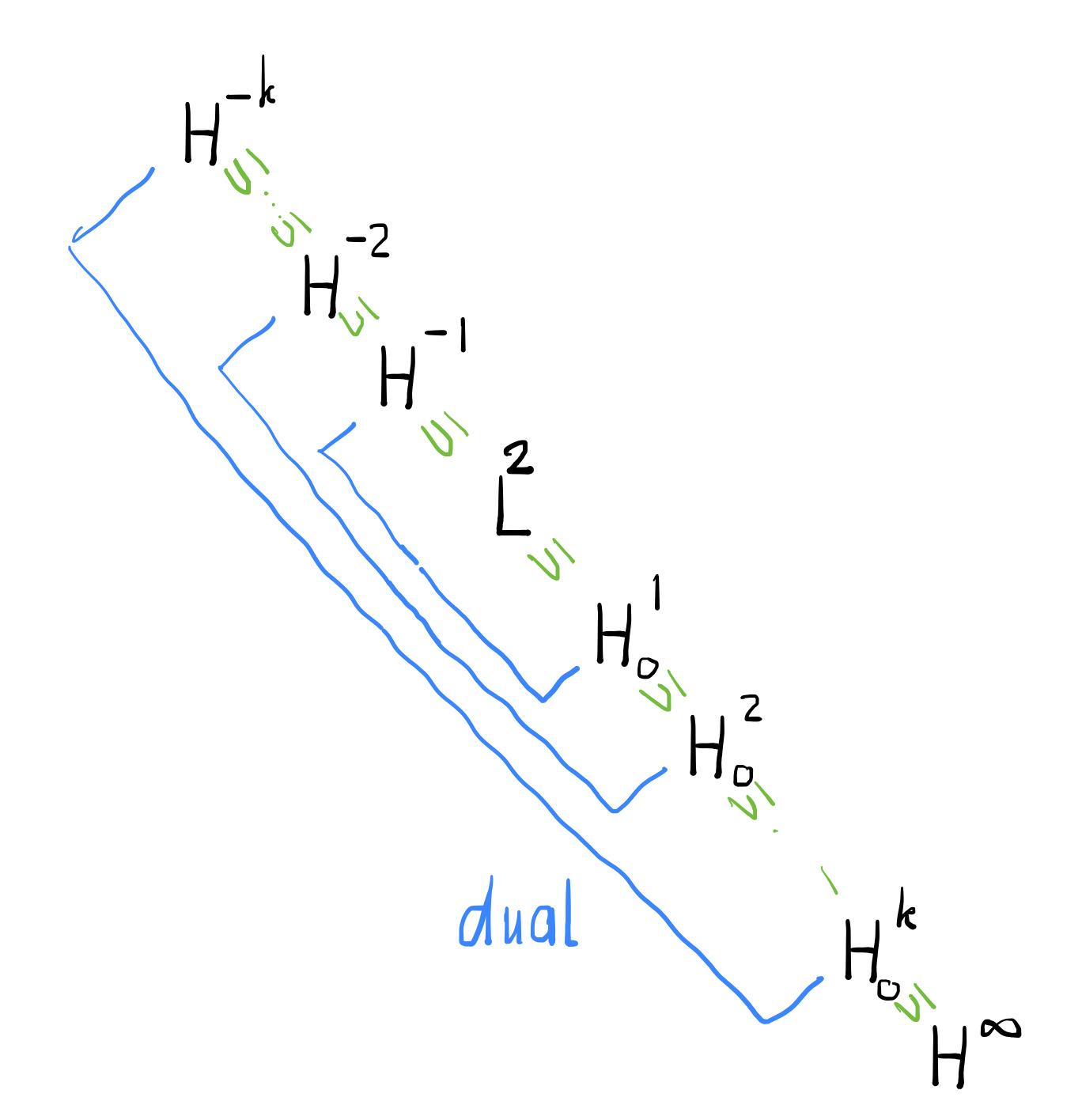
The dual space of \(H_0^k\) is defined as the (Hilbert-) dual space
\begin{equation*}
H^{-k} :=\left(H_0^k(\Omega)\right)^*.
\end{equation*}
Lemma 6.2.15.
Let \(f\in H^{-k}\text{.}\) Then there are functions \(g_\alpha\in L^2\) such that
\begin{equation*}
f= \sum_{|\alpha|=k} D_d^\alpha g_\alpha.
\end{equation*}
Proof.
\begin{equation*}
f(v) = (u_f, v)_{H_0^k} \qquad \mbox{for all} \quad v\in H_0^k.
\end{equation*}
In particular for \(\phi\in C_c^\infty\) we have
\begin{equation*}
f(\phi) = (u_f, \phi)_{H_0^k} =\sum_{|\alpha|=k} (D^\alpha u_f , D^\alpha \phi) = \sum_{|\alpha|=k} (-1)^{|\alpha|} (D^{2\alpha} u_f, \phi).
\end{equation*}
Hence we have the representation of \(f\) as
\begin{equation*}
f = \sum_{|\alpha|=k} (-1)^{|\alpha|} D^{2\alpha} u_f = \sum_{|\alpha|=k} D^\alpha \left( (-1)^{|\alpha|} D^\alpha u_f\right),
\end{equation*}
where
\begin{equation*}
g_\alpha = (-1)^{|\alpha|} D^\alpha u_f\in L^2.
\end{equation*}
Proposition 6.2.17.
Denote by \(B^n_1\) the \(n\)-dimensional ball of radius 1. Then \(\delta_0\in H^1(B^n_1)\) if and only if \(n=1\text{.}\)Proof.
\begin{equation*}
\delta_0 = \frac{1}{\omega_n}\nabla\cdot\left[\frac{x}{|x|^n}\right],
\end{equation*}
where \(\omega_n\) is the \(n-1\)-volume of \(\partial\Omega^n_1\text{.}\) For \(n=1\text{,}\) \(\frac{x}{|x|^n}\in L^2_{loc}(B^n_1)\) and so, by the proposition above, \(\delta_0\in H^1(B^1_1)\text{.}\) For \(n>1\text{,}\) \(\frac{x}{|x|^n}\not\in L^2_{loc}(B^n_1)\) and so \(\delta_0\not\in H^1(B^n_1)\text{.}\)Remark 6.2.18.
Each space \(H^k_0(\Omega)\) is a Hilbert space and so it is isometrically isomorphic to its dual \(H^{-k}(\Omega)\text{.}\) Unlike the case of \(L^2\text{,}\) though, this isomorphism is not natural because there are several equivalent norms in \(H^{-k}\text{.}\) For instance, \(\|\partial_x u\|_{L^2}+\|\partial_y u\|_{L^2}\) and \(\max\{\|\partial_x u\|_{L^2},\|\partial_y u\|_{L^2}\}\) give rise to the same topology on \(H^1_0(\bR)\text{.}\) Since \(\delta_0\in H^{-1}(\bR)\text{,}\) this isomorphism helps understanding that, when we say that "\((L^2)^*\simeq L^2\)", we have always to remember that the elements of \((L^2)^*\) are functionals, not functions. So, let us use on \(H^1_0(\bR)=H^1(\bR)\) the scalar product
\begin{equation*}
\langle u,v\rangle =\int_\bR(uv+u'v')dx.
\end{equation*}
Then the Riesz map
\begin{equation*}
R:H^1(\bR)\to H^{-1}(\bR),\quad v\mapsto\eta_v=\langle \cdot,v\rangle
\end{equation*}
is an isometric isomorphism. Integrating by parts, we see that
\begin{equation*}
\eta_v(u) = \int_\bR(uv-uv'')dx,
\end{equation*}
namely, in distributional sense,
\begin{equation*}
R(v) = \left(1-\frac{d^2}{dx^2}\right)v.
\end{equation*}
Hence, the function corresponding under this identification to \(\delta_0\) is given by the (unique!) solution to
\begin{equation*}
\left(1-\frac{d^2}{dx^2}\right)v=\delta_0,
\end{equation*}
namely \(v'' = v - \delta_0\text{.}\) We show below that the solution to this equation is
\begin{equation*}
v(x)=\frac{1}{2}e^{|x|}.
\end{equation*}
Definition 6.2.19.
The Fourier transform of \(u\in L^2(\bR^n)\) is the function
\begin{equation*}
\hat u(\xi) = \int_{\bR^n}u(x) e^{-2\pi i\,x\cdot\xi}dx.
\end{equation*}
Theorem 6.2.20.
The map \(u\to\hat u\) is an isometry of \(L^2(\bR^n)\) in itself.Theorem 6.2.21.
\begin{equation*}
H^{-s}(\bR^n) = \left\{\eta\in\cS^*\,:\,(1+|\xi|^2)^{-s/2}\hat\eta(\xi)\in L^2(\bR^n)\right\}
\end{equation*}
with norm
\begin{equation*}
\|\eta\|^2_{H^{-s}} = \int_{\bR^n}(1+|\xi|^2)^{-s}|\hat\eta(\xi)|^2\,d\xi.
\end{equation*}
Equivalently,
\begin{equation*}
H^{-s}(\bR^n) = (1-\Delta)^{s/2}(L^2(\bR^2)).
\end{equation*}
\begin{equation*}
H^\infty(\Omega) = \bigcap_{k\in\bN}H^{k}(\Omega)
\end{equation*}
Theorem 6.2.22.
Assume that \(\Omega\) is bounded and has a smooth boundary. The following holds:- \(\cS(\bR^n)^* = \bigcup_{k\in\bN}H^{-k}(\bR^n)\text{.}\)
- \(H^{\infty}(\bR^n)\subset C^\infty(\bR^n)\text{.}\)
- \(H^{\infty}(\Omega) = C^\infty(\bar\Omega)\text{.}\)
\begin{equation*}
\Delta u\in H^{-1}.
\end{equation*}
Indeed, consider the Poisson PDE with Dirichlet boundary conditions
\begin{equation*}
\Delta u = f,\;u|_{\partial\Omega}=0.
\end{equation*}
The weak formulation of the PDE is
\begin{equation*}
\int_\Omega \nabla u\cdot\nabla\phi dx = \langle f,\phi\rangle\text{ for all }\phi\in H^1_0(\Omega).
\end{equation*}
Hence, this equation makes sense for every \(f\in F^{-1}(\Omega)\text{.}\) Example 6.2.23. A simple example in dimension 1.
\begin{equation*}
\Delta u = \delta_0
\end{equation*}
in \(H_0^1((-1,1))\text{.}\) Then
\begin{equation*}
u(x) = \begin{cases}
-\frac{x+1}{2},\amp-1\leq x\leq0\\
-\frac{x-1}{2},\amp0\leq x\leq1\\
\end{cases}
\end{equation*}
\begin{equation*}
{\cal F}f(y) = \int_\bR f(x)e^{-2\pi i xy} dx.
\end{equation*}
Then
\begin{equation*}
{\cal F}f'(y) =
\int_\bR f'(x)e^{-2\pi i xy} dx =
2\pi i y \int_\bR f(x)e^{-2\pi i xy} dx = 2\pi i y {\cal F}f(y)
\end{equation*}
and so also
\begin{equation*}
{\cal F}f''(y) =
- 4\pi^2 y^2 {\cal F}f(y).
\end{equation*}
Hence, in case of the example above,
\begin{equation*}
u'' = \delta_0
\end{equation*}
becomes
\begin{equation*}
{\cal F}u'' = {\cal F}\delta_0,
\end{equation*}
namely
\begin{equation*}
-4\pi^2 y^2 {\cal F}u(y) = \int_\bR \delta_0(x)e^{-2\pi i xy} dx = 1,
\end{equation*}
so
\begin{equation*}
{\cal F}u(y) = \frac{1}{-4\pi^2 y^2}.
\end{equation*}
Thus,
\begin{equation*}
u(x) = \int_\bR \frac{e^{2\pi i xy}}{-4\pi^2 y^2}dy = -\frac{|x|}{2}.
\end{equation*}
The general solution is therefore
\begin{equation*}
u(x) = -\frac{|x|}{2} + ax + b.
\end{equation*}
Consider now the case discussed in Remark 6.2.18
\begin{equation*}
u'' = u - \delta_0\in H^{-1}(\bR).
\end{equation*}
Then, applying the Fourier transform, we get
\begin{equation*}
(1+4\pi^2 y^2) {\cal F}u(y) = 1,
\end{equation*}
namely
\begin{equation*}
{\cal F}u(y) = \frac{1}{1+4\pi^2 y^2},
\end{equation*}
so that
\begin{equation*}
u(x) = \frac{1}{2}e^{-|x|}\in H^1(\bR).
\end{equation*}
The general solution is
\begin{equation*}
u(x) = \frac{1}{2}e^{-|x|} + A e^x + Be^{-x}.
\end{equation*}