
Section 9.1 Introduction
Evolution PDEs can be seen as ODEs on infinite dimensional spaces. For example, consider a reaction diffusion equation
\begin{equation*}
u_t = D\Delta u + f(u)
\end{equation*}
which we write as
\begin{equation*}
u_t = A u + f(u) , \qquad u(t,\cdot) \in H^2(\Omega).
\end{equation*}
Some ideas to think about: - Consider the linear case \(\dot u = Au\text{.}\) If \(A\) were a matrix and \(u(t)\in \RR^n\) then we could simply use the matrix exponential to solve the differential equation\begin{equation*} u(t) = e^{A t} u_0. \end{equation*}The exponential matrix (or matrix exponential)\begin{equation} e^{At} = \sum_{n=0}^\infty \frac{A^n}{n !} t^n \label{expop}\tag{9.1.1} \end{equation}is well defined by its power series. In fact, by the Caley-Hamilton theorem \(e^{At}\text{,}\) for given \(t\text{,}\) is only a finite series, and there is no worry about convergence.
- If \(A\) is a bounded operator we can still use the same series (9.1.1) to define an operator exponential. The series might be infinite, but it still converges in the operator norm and is bounded by \(e^{\|A\|}\text{.}\)
- But what if \(A\) is an unbounded operator, for example \(A=\Delta\text{?}\) If we write a formula like (9.1.1), then \(u\) would need to be \(C^\infty\) such that all derivatives make sense.
- The question arises if there is a better way to define \(e^{A}\) if \(A\) is unbounded? Here are a few ideas:
-
Idea 1: Use diagonalization. For a matrix \(A\in \RR^{n\times n}\) we can find its Jordan normal form \(J\) and an orthogonal transformation \(Q\) such that \(A=Q^{-1} J Q\text{.}\) Then\begin{equation*} e^A = e^{Q^{-1} J Q} = Q^{-1} e^J Q \end{equation*}and we have methods to compute \(e^J\text{.}\) How about unbounded Banach spaces? Something like a Jordan form does not exist in an infinite dimensional context.
-
Idea 2: We use the limit definition of an exponential\begin{equation*} e^{A} = \lim_{n\to \infty} \left (I +\frac{A}{n}\right)^n. \end{equation*}Again we are facing the problem of using higher orders of \(A^n\text{,}\) restricting the available function spaces.
-
Idea 3: We could use the inverse limit formula for the exponential\begin{equation*} e^A = \lim_{n\to \infty} \left(I-\frac{A}{n}\right)^{-n}, \end{equation*}which we need to read in the correct operator-way as\begin{equation} e^A = \lim_{n\to \infty} \left[\left( I-\frac{A}{n}\right)^{-1}\right]^n = \lim_{n\to \infty} \left[ -n R_{n} (A)\right]^n \tag{9.1.2} \end{equation}using the resolvent. This looks complicated, but it actually works! For an unbounded operator the resolvent, when it exists, is very well behaved, and taking it to some large power is no problem.
-
Idea 4: Using the Chauchy-integral formula for the exponential\begin{equation*} e^A = \frac{1}{2\pi i} \int_C e^\lambda (\lambda I- A)^{-1} d\lambda, \end{equation*}where \(C\subset \CC\) is a closed, simple, rectifiable, positive oriented curve that encloses the spectrum of \(A\text{.}\) This method seems very far fetched, but as we will see, it works too! In particular for analytic semigroups. In Figure 9.1.1 we illustrate this idea for a bounded operator on the left (A) and for an analytic semigroup on the right (B).
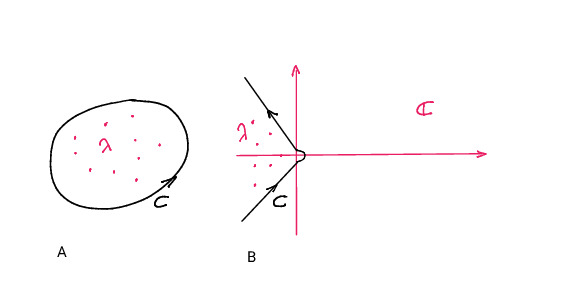
Figure 9.1.1. Illustration of idea 4. Using the Cauchy integral formula over a path \(C\) the encircles the spectrum of \(A\) might become a useful definition of an operator exponential. - A proper definition will arise from the properties of the matrix exponential, which we call the semigroup properties, and the concept of an infinitesimal generator \(A\text{.}\)
Definition 9.1.2.
Let \(X\) be a Banach space. A family \(\{T(t)\}_{t\geq 0}\) of bounded linear operators in \(X\) is called a strongly continuous semigroup or \(C^0\)-semigroup, if it satisfies- \(T(t+s)= T(t)T(s), \qquad t,s\geq 0\text{,}\) (semigroup property)
- \(T(0) = I\text{,}\)
- For all \(u\in X\) the map \(t\mapsto T(t) u\) is continuous in \(X\text{.}\) Note that it is sufficient to check continuity at \(t=0\text{.}\)
Example 9.1.3.
\begin{equation*}
\lim_{t\to 0} \|T(t) u \|_\infty = \lim_{t\to 0} \|u(t+x) \|_\infty = |u(x)|,
\end{equation*}
Let us now look at the simple first order, linear, partial differential equation
\begin{equation}
u_t - u_x =0 .\label{leftshift}\tag{9.1.3}
\end{equation}
This equation on \(\RR\) is solved by a traveling wave \(u(x,t) = u(x+t) = T(t) u(x)\text{.}\) Hence \(T(t)\) is the solution semigroup of ((9.1.3)). In this sense we could say
\begin{equation*}
T(t) = e^{t \frac{ \partial}{\partial x} }.
\end{equation*}
Note that equation ((9.1.3)) needs \(u\in C^1\text{,}\) while \(T(t)\) only needs \(u\in C^0\text{.}\)Proposition 9.1.4.
Let \(\omega:[0,\infty) \to \RR\) be bounded on any finite interval and subadditive \(\omega(t_1+t_2) \leq \omega(t_1)+\omega(t_2),\) then
\begin{equation}
\inf_{t>0} \frac{\omega(t)}{t} = \lim_{t\to \infty} \frac{\omega(t)}{t},\tag{9.1.4}
\end{equation}
where the limit might be equal to \(-\infty\text{.}\)Proof.
\begin{equation*}
\frac{\omega(t)}{t} \leq \frac{n\omega(t_0) + \omega(r)}{t}.
\end{equation*}
As we take the limit \(n\to\infty\) we get \(t\to \infty\) and \(\frac{n}{t}\to \frac{1}{t_0}\text{.}\) The second term on the right hand side satisfies
\begin{equation*}
\frac{\omega(r)}{t} \leq \sup_{s\in[0, t_0)} \frac{\omega(s)}{t} \to 0 \mbox{ for }t\to\infty.
\end{equation*}
Then
\begin{equation*}
\limsup_{t\to \infty} \frac{\omega(t)}{t}\leq \frac{\omega(t_0)}{t_0} <\gamma,
\end{equation*}
for all \(\gamma>\omega_0\text{.}\) Hence \(\lim_{t\to\infty} \frac{\omega(t)}{t} \) exists and equals \(\omega_0\text{.}\)Theorem 9.1.5.
Let \(\{T(t)\}\)\(t\geq 0\) be a strongly continuous semigroup of bounded linear operators on a Banach space \(X\text{.}\) Then
\begin{equation*}
\omega_0 = \lim_{t\to\infty} \frac{\ln \|T(t)\|}{t}
\end{equation*}
exists (or is \(-\infty\)). For every \(\gamma>\omega_0\) there is a constant \(M_\gamma>0\) such that
\begin{equation*}
\|T(t)\|\leq M_\gamma e^{\gamma t}.
\end{equation*}
The growth rate \(\omega_0\) identifies the type of the semigroup, which is exponentially decaying for \(\omega_0<0\) and exponentially growing for \(\omega_0>0\text{.}\)Proof.
\begin{equation*}
\ln \|T(t+s)\|\leq \ln \|T(t)\| + \ln \|T(s) \|
\end{equation*}
and \(\|T(t)\|\) is bounded on bounded intervals. Hence by the previous Proposition 9.1.4 the limit \(\omega_0\) exists. For each \(\gamma>\omega_0\) and for \(t>t_0\) for some \(t_0>0\) we then have
\begin{equation*}
\frac{\ln\|T(t)\|}{t}\leq \gamma \qquad \mbox{for all }\quad t>t_0,
\end{equation*}
which implies
\begin{equation*}
\|T(t)\|\leq e^{\gamma t} \qquad \mbox{for all }\quad t>t_0.
\end{equation*}
We set
\begin{equation*}
M_\gamma = \max\left\{1, \sup_{t\in[0,t_0]} \|T(t)\|e^{-\gamma t} \right\}.
\end{equation*}
Example 9.1.6.
\begin{equation*}
\|T(t) \|=\sup_{\|u\|_\infty =1} \|T(t)u\|_\infty = \sup_{\|u\|_\infty=1} \|u(x+t)\|_\infty = 1.
\end{equation*}
Then \(\ln\|T(t)\|/t = 0/t =0=\omega_0. \) The semigroup shows no growth or decay, it is simply a shift to the left.