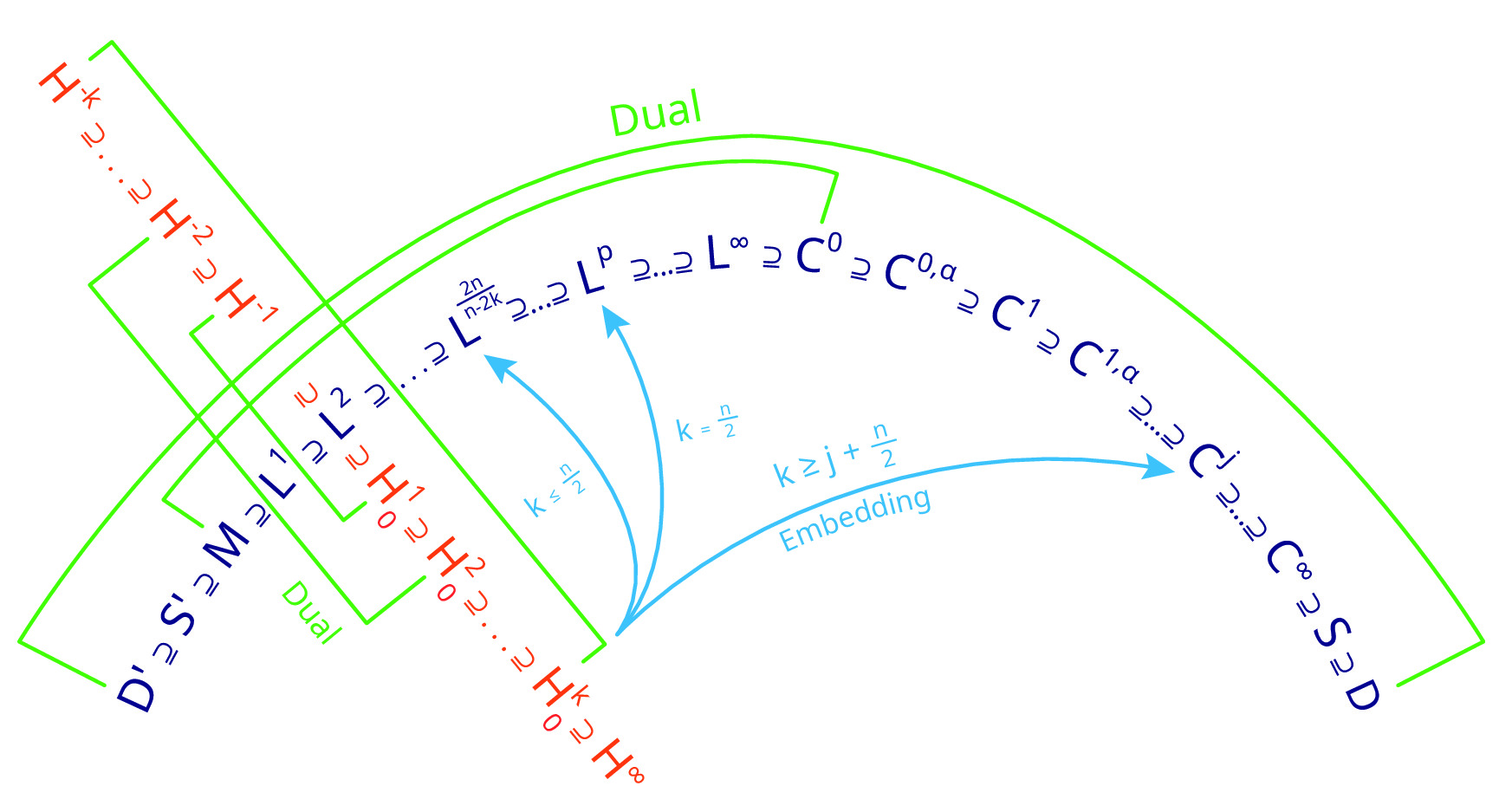
Section 6.3 Embeddings
Definition 6.3.1.
An embedding for \(X\) into \(Y\) is a structure preserving injective map \(\Psi\text{.}\) In case of Banach spaces, the structure that is preserved is the norm in the sense that \(\|\Psi(u) \|_Y \leq \|u\|_X \text{.}\) We write an embedding as
\begin{equation*}
X\hookrightarrow Y.
\end{equation*}
A compact embedding
\begin{equation*}
X\Subset Y
\end{equation*}
maps bounded sets in \(X\) into relatively compact sets in \(Y\text{.}\)Theorem 6.3.2.
Let \(\Omega\subset\RR^n\) be bounded with \(C^\infty\) boundary and set \(p^*=\frac{np}{n-kp}\) (this is called Sobolev exponent). Then:- If \(kp<n\text{,}\) then \(W^{k,p}(\Omega)\Subset L^q(\Omega)\) for every \(q\in[p,p^*)\) and \(W^{k,p}(\Omega)\hookrightarrow L^{p^*}(\Omega)\text{.}\)
- If \(kp=n\text{,}\) then \(W^{k,p}(\Omega)\Subset L^q(\Omega)\) for every \(q\in[p,\infty)\text{.}\)
- If \(kp>n\text{,}\) then \(W^{k,p}(\Omega)\Subset L^\infty(\Omega)\text{.}\)
Proof.
\begin{equation*}
u(x)
=
\int_{-\infty}^{x_1}
\partial_1 u(t,x_2,\dots,x_n)\,dt .
\end{equation*}
Taking absolute values,
\begin{equation*}
|u(x)|
\le
\int_{-\infty}^{x_1}
|\partial_1 u(t,x_2,\dots,x_n)|\,dt .
\end{equation*}
Repeating this argument in each coordinate direction and multiplying the resulting inequalities, we obtain
\begin{equation*}
|u(x)|^n
\le
\prod_{i=1}^n
\int_{-\infty}^{x_i}
|\partial_i u(x_1,\dots,t,\dots,x_n)|\,dt .
\end{equation*}
Integrating both sides over \(\mathbb R^n\) and applying Fubini's theorem yields
\begin{equation*}
\int_{\mathbb R^n} |u(x)|^n\,dx
\le
\prod_{i=1}^n
\int_{\mathbb R^n} |\partial_i u(x)|\,dx .
\end{equation*}
Applying Holder's inequality with exponent \(p\) to each factor gives
\begin{equation*}
\int_{\mathbb R^n} |u|^n
\le
C
\prod_{i=1}^n
\|\partial_i u\|_{L^p(\mathbb R^n)}
\le
C \|\nabla u\|_{L^p(\mathbb R^n)}^n .
\end{equation*}
Replacing \(u\) by \(|u|^{\frac{p(n-1)}{n-p}}\) and simplifying the exponents yields
\begin{equation*}
\|u\|_{L^{p^*}(\mathbb R^n)}
\le
C \|\nabla u\|_{L^p(\mathbb R^n)} .
\end{equation*}
Finally, since \(C_c^\infty(\mathbb R^n)\) is dense in \(W^{1,p}(\mathbb R^n)\text{,}\) the inequality extends by continuity to all of \(W^{1,p}(\mathbb R^n)\text{.}\)Corollary 6.3.3.
Set \(p^*=\frac{2n}{n-2k}\text{.}\) Then- If \(2k<n\text{,}\) then \(H^{k}(\Omega)\Subset L^q(\Omega)\) for every \(q\in[2,p^*)\) and \(H^{k}(\Omega)\hookrightarrow L^{p^*}(\Omega)\text{.}\)
- If \(2k=n\text{,}\) then \(H^{k}(\Omega)\Subset L^q(\Omega)\) for every \(q\in[p,\infty)\text{.}\)
- If \(2k>n\text{,}\) then \(H^{k}(\Omega)\Subset L^\infty(\Omega)\text{.}\)
Remark 6.3.4.
In Remark 6.3.4 the Rainbow of Function Spaces, we summarize all the inclusions and embeddings that we discussed so far. We obtain a scale of spaces from the largest measure space \(\mathcal{D}'\) to the smallest function space here, which is \(C_c^\infty\text{.}\) The spaces are related by inclusions, embeddings and as dual spaces and they include spaces of differentiable funcitons, spaces of H\"older continuous functions, spaces of integrable functions and Sobolev spaces. Sobolev embeddings make interesting short-cuts between these spaces.