
Section 6.1 Distributional and Weak Derivatives
First we define distributions and the distributional derivative. We consider \(\Omega\subset\RR\) and define the set of test functions as
\begin{equation*}
\mathcal{D}(\Omega) := C_c^\infty(\Omega).
\end{equation*}
Note that \(\mathcal{D}(\Omega)\) is not a Banach space, since it is not closed with respect to the sup-norm.
Definition 6.1.1.
- A distribution (generalized function) \(f\in \mathcal{D}'(\Omega)\) is continuous in the following sense: If \(\phi_n\to\phi\) in \(\mathcal{D}(\Omega)\text{,}\) then \(f(\phi_n)\to f(\phi)\) in \(\RR\text{.}\) We often write the linear map induced by \(f\) as\begin{equation*} (f,\phi) = f(\phi). \end{equation*}
- Given \(f\in\mathcal{D}'(\Omega)\text{.}\) The distributional derivative of \(f\) is defined as a distribution \(v\in \mathcal{D}'(\Omega)\) that satisfies\begin{equation*} (v,\phi) = -\left(f, \frac{d\phi}{dx}\right), \qquad\mbox{for all} \qquad \phi\in \mathcal{D}(\Omega). \end{equation*}
\begin{equation*}
\mathcal{S}(\RR) =\left\{\phi\in C^\infty(\RR): \left\||x|^k \left(\frac{d}{dx}\right)^\alpha \phi \right\|_\infty <\infty, \quad \mbox{for all}\quad k\geq 0, \alpha \geq 0\quad\mbox{multiindex}. \right\}.
\end{equation*}
Elements of the dual space \(\mathcal{S}(\Omega)\) are then called tempered distributions. Note that
\begin{equation*}
\mathcal{D}(\Omega)\subset \mathcal{S}(\Omega), \qquad \mbox{hence} \qquad \mathcal{S}'(\Omega) \subset \mathcal{D}'(\Omega),
\end{equation*}
each tempered distribution is automatically a distribution. We call the distributional derivative a weak derivative, if it is integrable: Definition 6.1.2.
Consider \(f\in L^1_{\tiny loc}(\Omega)\text{.}\) If the distributional derivative of \(f\) satisfies \(f'\in L^1_{\tiny loc}(\Omega)\text{,}\) then we call it the weak derivative of \(f\text{.}\)
\begin{equation*}
\int_\Omega v \phi dx = -\int_\Omega f\frac{d\phi}{dx} dx \qquad \mbox{for all}\quad \phi\in \mathcal{D}(\Omega).
\end{equation*}
We write
\begin{equation*}
v=f'=\frac{df}{dx} = Df .
\end{equation*}
If \(u\) is differentiable and \(\phi\) has compact support, then from integration by parts we have
\begin{equation*}
\int_\Omega \frac{du}{dx} \phi dx = -\int_\Omega u\frac{d\phi}{dx} dx,
\end{equation*}
hence weak and classical derivative coincide for differentiable functions. If \(\alpha\) is a multiindex, then the weak derivative can be generalized as
\begin{equation*}
\int_\Omega D^\alpha u \; \phi dx = (-1)^{|\alpha|} \int_\Omega u D^\alpha \phi dx, \qquad \mbox{for all}\quad \phi\in \mathcal{D}(\Omega).
\end{equation*}
Example 6.1.3.
\begin{equation}
u(x) = \left\{\begin{array}{ll} x^2, \amp\qquad 0\leq x<1\\
1, \amp \qquad 1<x\leq 2 \end{array} \right..\tag{6.1.1}
\end{equation}
Then, using the definition of the weak derivative, we find for each test function \(\phi\in \mathcal{D}([0,2])\) that
\begin{align*}
\int_0^2 \frac{du}{dx} \phi dx \amp=\amp -\int_0^2 u \phi' dx = -\int_0^1 x^2 \phi' dx - \int_1^2 \phi' dx\\
\amp=\amp -x^2 \phi|_0^1 +\int_0^1 2x \phi dx - \phi(2) + \phi(1)\\
\amp=\amp-\phi(1) +\int_0^1 2x \phi dx + \phi(1)\\
\amp=\amp \int_0^1 2x \phi dx + \int_1^2 0\cdot \phi dx.
\end{align*}
Hence the distributional derivative is
\begin{equation}
u'(x) = \left\{\begin{array}{ll} 2x, \amp\qquad 0\leq x<1\\
0, \amp \qquad 1<x\leq 2 \end{array} \right..\tag{6.1.2}
\end{equation}
This is clearly integrable on \([0,2]\text{,}\) hence it is also the weak derivative of \(u\text{.}\)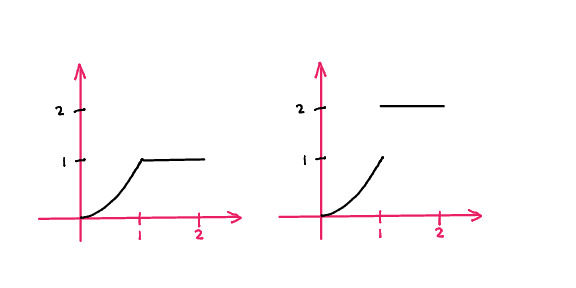
Example 6.1.5.
\begin{equation}
u(x) = \left\{\begin{array}{ll} x^2, \amp\qquad 0\leq x<1\\
2, \amp \qquad 1<x\leq 2 \end{array} \right.\tag{6.1.3}
\end{equation}
Then, for each test function \(\phi\in \mathcal{D}([0,2])\) we have
\begin{align*}
\int_0^2 \frac{du}{dx} \phi dx \amp=\amp -\int_0^2 u \phi' dx = -\int_0^1 x^2 \phi' dx - \int_1^2 2 \phi' dx\\
\amp=\amp -x^2 \phi|_0^1 +\int_0^1 2x \phi dx - 2 \phi(2) + 2 \phi(1)\\
\amp=\amp-\phi(1) +\int_0^1 2x \phi dx + 2 \phi(1)\\
\amp=\amp \int_0^1 2x \phi dx + \int_1^2 0\cdot \phi dx +\phi(1).
\end{align*}
Here the question arises how to write the evaluation \(\phi(1)\) as a linear map \(\phi\mapsto \phi(1)\text{.}\) The Dirac delta distribution is the answer. We define \(\delta\in\mathcal{D}'(\Omega)\) by its action
\begin{equation*}
(\delta_x, \phi) = \phi(x), \qquad \mbox{for all}\quad \phi\in\mathcal{D}(\Omega).
\end{equation*}
Then the distributional derivative is
\begin{equation}
u'(x) = \delta_1(x) + \left\{\begin{array}{ll} 2x, \amp\qquad 0\leq x<1\\
0, \amp \qquad 1<x\leq 2 \end{array} \right..\tag{6.1.4}
\end{equation}
This is not integrable on \([0,2]\text{,}\) since \(\delta_1\) it is not a measurable function, it is a distribution. Hence we find a distributional derivative which is not a weak derivative of \(u\text{.}\)