
Section 5.5 Dual Spaces
In this section we provide several examples of dual spaces.Subsection 5.5.1 Dual of a Hilbert Space
In a Hilbert space the dual can be identified with the original space. This is the key result of the Riesz Representation Theorem.Theorem 5.5.1. Riesz Representation Theorem.
Let \(H\) be a Hilbert space and let \(\rho:H\to H^*\) be the map such that
\begin{equation*}
\rho(v)=\langle v,\cdot\rangle.
\end{equation*}
Then \(\rho\) is a surjective isometry. In particular, \(H\) is isometrically isomorphic to \(H^*\text{.}\)Proof.
\begin{equation*}
\|\rho(v)\|_{H^*} = \sup_{w\neq0}\frac{|\langle v,w\rangle|}{\|w\|_H}\leq\|v\|_H.
\end{equation*}
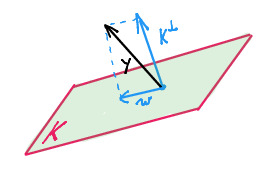
Since \(\frac{|\langle v,v\rangle|}{\|v\|_H}=\|v\|_H\text{,}\) it turns out that \(\|\rho(v)\|_{H^*}=\|v\|_H\text{.}\) Finally, we show that \(\rho\) is surjective. Let \(\eta\in H^*\text{.}\) Then, by , there is a vector \(v\in H\) such that \(\ker\eta^\perp=\span\{v\}\text{.}\) We claim that there is a \(\lambda\) such that
\begin{equation*}
\eta(w) = \langle\lambda v,w\rangle
\end{equation*}
for all \(w\in H\text{.}\) Indeed, \(w=w_0\oplus\mu v\text{,}\) with \(w_0\in\ker\eta\text{,}\) so that
\begin{equation*}
\eta(w) = \mu \eta(v)
\end{equation*}
and
\begin{equation*}
\langle\lambda v,w\rangle = \lambda\mu\|v\|^2_H.
\end{equation*}
Then \(\lambda=\frac{\eta(v)}{\|v\|^2_H}\) does the job, namely
\begin{equation*}
\eta(w) = \langle \frac{\eta(v)}{\|v\|^2_H}v,w\rangle
\end{equation*}
for all \(w\in H\text{.}\) Equivalently,
\begin{equation*}
\eta = \langle \frac{\eta(v)}{\|v\|^2_H}v,\cdot\rangle.
\end{equation*}
Subsection 5.5.2 \((L^p(\Omega))^* \simeq L^q(\Omega)\) for \(\frac{1}{p}+\frac{1}{q}=1\)
Let \(\Omega\) be any open subset of a manifold. Then there is an invertable isometry between \((L^p(\Omega))^*\) and \(L^q(\Omega)\text{,}\) where \(q\) is the unique solution of \(\frac{1}{p}+\frac{1}{q}=1\text{,}\) for every \(p\in(1,\infty)\text{.}\) For a bounded smooth set \(\Omega\) and for \(1<p<\infty\) we use Hahn-Banach to show that \((L^p(\Omega))^*=L^q(\Omega)\text{,}\) where \(p\) and \(q\) are conjugate. For \(f\in L^q(\Omega)\) we define a linear functional through integration
\begin{equation*}
\Phi_f(g) = \int_\Omega f(x) g(x) dx .
\end{equation*}
By H\"olders inequality we have
\begin{equation*}
|\Phi_f(g) |\leq \|f\|_q \|g\|_p.
\end{equation*}
This shows that \(\Phi_f\in (L^p(\Omega))^*\) and that \(\|\Phi_f\|_{op}\leq \|f\|_q\text{.}\) But we can get more. We can show that we have an isometry between \(L^q\) and \((L^p)^*\text{.}\) To show this we choose \(g(x) = |f(x)|^{q-2} f(x) \text{.}\) Then
\begin{equation}
\|g\|_p^p = \int_\Omega \left||f(x)^{q-2} f(x) \right|^p dx
= \int_\Omega |f(x) |^q dx
= \|f\|_q^q. \tag{5.5.1}
\end{equation}
Hence \(\|g\|_p = \|f\|_q^{\frac{q}{p}}\text{.}\) Now
\begin{equation*}
|\Phi_f(g) | = \int_\Omega f(x) |f(x)|^{q-2} f(x) dx = \int_\Omega |f(x)|^q dx = \|f\|_q^q = \|f\|_q \|f\|_q^{\frac{q}{p}} = \|f\|_q \|g\|_p.
\end{equation*}
Hence
\begin{equation*}
\|\Phi_f\|_{(L^p)^*} = \|\Phi_f\|_{op} = \|f\|_q,
\end{equation*}
and the map \(L^q(\Omega) \to (L^p(\Omega))^*\) is an isometry. What is missing is to show that each element in \((L^p)^*\) can be written as an integral operator. This is done via measure theory, and not covered in this book, but can be found in Halmos. A simple proof can be done for \(p\in[1,2]\text{.}\) When \(p=2\text{,}\) it is enough using the Riesz Representation Theorem 5.5.1. Assume now that \(p\in[1,2)\) and assume, to make things simpler, that the measure of \(\Omega\) is 1. Then the identity map \(i:L^2(\Omega)\to L^p(\Omega)\) is a dense continuous embedding with \(\|f\|_{L^p(\Omega)}\leq\|f\|_{L^2(\Omega)}\text{.}\) Hence, by Proposition 5.3.5, \(i^*:(L^p(\Omega))^*\to (L^2(\Omega))^*\) is a continuous embedding and \(\|\eta\|_{(L^2(\Omega))^*}\leq\|\eta\|_{(L^p(\Omega))^*}\text{ for all }\eta\in(L^p(\Omega))^*.\) This means that every \(\eta\in(L^p(\Omega))^*\) is an element of \((L^2(\Omega))^*\) such that \(|\eta(f)|\leq K\|f\|_{L^p(\Omega)}\) for all \(f\in L^p(\Omega)\) and some \(K>0\text{.}\) As pointed out above, by the Riesz Representation we have that there is a \(g\in L^2(\Omega)\) such that
\begin{equation*}
\eta(f) = \int_\Omega g(s)f(s)d\mu(s)\text{ for all }f\in L^2(\Omega).
\end{equation*}
We claim that \(g\in L^q(\Omega)\text{.}\) To see this, we consider the sequence
\begin{equation*}
f_k(x) = \min\{|g(x)|,k\}^{q-1}\sgn u(x).
\end{equation*}
Notice that, for every \(k=1,2,\dots\text{,}\) \(f_k\in L^2(\Omega)\) and
\begin{equation*}
\eta(f_k) = \int_\Omega \min\{|g(s)|,k\}^{q-1} |g(s)| d\mu(s) \geq \int_\Omega \min\{|g(s)|,k\}^{q}d\mu(s) = \|f_k\|^p_{L^p(\Omega)}.
\end{equation*}
On the other side, by assumption,
\begin{equation*}
K \|f_k\|^p_{L^p(\Omega)} \geq |\eta(f_k)|,
\end{equation*}
so that
\begin{equation*}
K \left(\int_\Omega \min\{|g(s)|,k\}^{q}d\mu(s)\right)^{1/p}\geq \int_\Omega \min\{|g(s)|,k\}^{q}d\mu(s).
\end{equation*}
Since \(1/q=1-1/p\text{,}\) this means that
\begin{equation*}
\|\min\{|g(s)|,k\}^{q}d\mu(s)\|_{L^q(\Omega)}\leq K\text{ for all }k=1,2,\dots,
\end{equation*}
namely \(g\in L^q(\Omega)\text{.}\) In any case, we have
\begin{equation*}
(L^p(\Omega))^* \simeq L^q(\Omega)
\end{equation*}
and we simply write
\begin{equation*}
(L^p(\Omega))^* = L^q(\Omega).
\end{equation*}
Because of the symmetry between \(p\) and \(q\text{,}\) this also shows that \(L^p\) spaces are reflexive for every \(p\in(1,\infty)\text{.}\)Subsection 5.5.3 \((L^1(\Omega))^* \simeq L^\infty(\Omega)\) but \((L^\infty(\Omega))^* \supsetneq L^1(\Omega)\)
For \(f\in L^\infty(\Omega)\) we again define an integral operator as
\begin{equation*}
\Phi_f(g) = \int_\Omega f(x) g(x) dx,
\end{equation*}
with
\begin{equation*}
|\Phi_f(g) | \leq \|f\|_\infty \|g\|_1.
\end{equation*}
Similar as before we show that
\begin{equation*}
\|\Phi_f\|_{(L^1)^*} = \|\Phi_f\|_{op} = \|f\|_\infty
\end{equation*}
and we get an isometry
\begin{equation*}
(L^1(\Omega))^* = L^\infty(\Omega).
\end{equation*}
However, as we will not explicitly show here, we only have
\begin{equation*}
L^1(\Omega) \subsetneqq (L^\infty )^* .
\end{equation*}
The dual space \(M(\Omega) = (L^\infty(\Omega))^*\) is a measure space equipped with the total variation norm \cite{halmos}).Subsection 5.5.4 \((L^p_{loc}(\bR))^* \simeq L^q_c(\bR)\) for \(\frac{1}{p}+\frac{1}{q}=1, p\in(1,\infty)\)
Recall that \(L^p_{loc}(\bR)\) is a Frechet space (see Subsection 3.6.2) and that \(f_n\to f\) in \(L^p_{loc}(\bR)\) if and only if \((f_n)|_{[-n,n]}\to f|_{[-n,n]}\) for every \(n=1,2,\dots\text{.}\) Denote by
\begin{equation*}
p_n(x) = \left(\int_{[-n,n]}|f(x)|^p dx\right)^{1/p}
\end{equation*}
the seminorms giving rise to the topology of \(L^p_{loc}(\bR)\) and let \(\eta\in L^p_{loc}(\bR)^*\text{.}\) Then, by Corollary 4.2.15, there is a \(N>0\) such that
\begin{equation*}
|\eta(f)| \leq M\cdot p_N(f)\text{ for all }f\in L^p_{loc}(\bR).
\end{equation*}
In particular, if the essential support of \(f\) is disjoint from \([-N,N]\text{,}\) we have that \(\eta(f) = 0\text{.}\) Hence, there is a \(\hat\eta\in L^p([-N,N])^*\) such that
\begin{equation*}
\eta(f) = \hat\eta(f)\text{ for all }f\in L^p_{loc}(\bR).
\end{equation*}
Since \([-N,N]\) is compact, \(L^p([-N,N])^*\simeq L^q([-N,N])\) and so there is a \(g\in L^q([-N,N])\) such that
\begin{equation*}
\eta(f) = \int_{[-N,N]}g(x)f(x)dx.
\end{equation*}
We can extend \(g\) to a \(\tilde g\in L^q_c(\bR)\) by setting \(\tilde g=g\) within \([-N,N]\) and \(\tilde g=0\) otherwise, so that
\begin{equation*}
\eta(f) = \int_{\bR}\tilde g(x)f(x)dx\text{ for all }f\in L^p_{loc}(\bR).
\end{equation*}
Hence, the natural map \(J:L^q_c(\bR)\to L^p(\bR)^*\) is surjective. It is also injective since, given any \(h\in L^q_c(\bR)\text{,}\)
\begin{equation*}
\int_{\bR}\tilde h(x)f(x)dx = 0\text{ for all }f\in L^p_{loc}(\bR)
\end{equation*}
implies that \(h=0\text{.}\) Indeed, as we already did above, for \(\tilde h(x) = |h(x)|^{q-2}h(x)\text{,}\) we have that
\begin{equation*}
\|\tilde h\|^p_{L^p(\bR)} = \|h\|^q_{L^q(\bR)},
\end{equation*}
so \(h\in L^p_{loc}(\bR)\) and
\begin{equation*}
0 = \int_\bR h(x)\cdot|h(x)|^{p-2}h(x)dx = \int_\bR |h(x)|^p dx = \|\tilde h\|^q_{L^q(\bR)}.
\end{equation*}
The reader can show that this isomorphism is also an isometry. Finally, this result actually holds for any open set \(\Omega\subset\bR^n\text{,}\) namely
\begin{equation*}
(L^p_{loc}(\Omega))^* \simeq L^q_c(\Omega)\text{ for }\frac{1}{p}+\frac{1}{q}=1, p\in(1,\infty)
\end{equation*}
Subsection 5.5.5 \((L^p_{c}(\bR))^* \simeq L^q_{loc}(\bR)\) for \(\frac{1}{p}+\frac{1}{q}=1, p\in[1,\infty)\)
We did not discuss above about the topology of \(L^p_{c}(\bR)\text{.}\) As the dual of \(L^q_{loc}(\bR)\text{,}\) the topology on \(L^p_{c}(\bR)\) (see Definition 4.2.16) is induced by the family of seminorms
\begin{equation*}
p_B(\eta) = \sup_{f\in B}|\eta(f)|, B\text{ bounded subset of }L^q_{loc}(\bR).
\end{equation*}
What are bounded subsets of \(L^q_{loc}(\bR)?\) Recall that (Definition 4.2.7) a subset of a Frechet space is bounded if every seminorm is bounded on it. Applied to this case, it means that a set \(B\subset L^q_{loc}(\bR)\) is bounded if, for every compact \(K\subset\bR\text{,}\) the set \(B_K\subset L^q(K)\) of the restrictions to \(K\) of all functions in \(B\) is bounded in \(L^q(K)\) (that is a Banach space). Recall \(\eta_n\to\eta\) in the strong "dual" topology means that \(p_B(\eta_n-\eta)\to0\) for every bounded subset \(B\) of \(L^q_{loc}(\bR)\text{.}\) We claim that this topology coincides with the "natural" topology on \(L^q_{loc}(\bR)\text{,}\) namely the topology of \(L^q\) convergence over compact sets. Indeed, assume that \(\eta_n\to\eta\) in the strong topology and let \(K\) be compact. Set
\begin{equation*}
B_K = \{f\in L^p_c(\bR) : \supp(f)\subset K, \|f\|_{L^p(K)}\leq1\}.
\end{equation*}
This is a bounded subset of \(L^p_{c}(\bR)\text{.}\) Hence
\begin{equation*}
\|g_n-g\|_{L^p(K)} = \sup_{\|f\|_{L^p(K)}\leq1}\int_K f(x)(g_n(x)-g(x))dx = \sup_{f\in B_K}\int_K f(x)(g_n(x)-g(x))dx = p_{B_K}(g_n-g)\to0,
\end{equation*}
namely \(g_n\to g\) in \(L^p(K)\text{.}\) Since this is true for every compact \(K\text{,}\) this means that strong convergence implies convergence over compacts. The reader can prove the inverse. Now we show that the dual of \(L^p_{c}(\bR)\) is \(L^q_{loc}(\bR)\text{.}\) The fact that \(L^q_{loc}(\bR)\subset(L^p_{c}(\bR))^*\) comes from the elementary observation that, given any \(f\in L^q_{loc}(\bR)\text{,}\) then the map
\begin{equation*}
\eta_f:g\mapsto\int_\bR f(x)g(x)dx
\end{equation*}
is well-defined, linear and continuous. Continuity comes from the observation that, given a compact \(K\) and a sequence \(f_n\) converging to \(f\) in \(L^q_{loc}(\bR)\text{,}\)
\begin{equation*}
\eta_f(g_n)-\eta_f(g)=\int_{K}(f_n(x)-f(x))g(x)dx
\leq\|f_n-f\|_{L^p(K)}\|g\|_{L^p(K)}\to0.
\end{equation*}
Hence, we just have to prove that all linear functionals on \(L^p_{c}(\bR)\) can be written this way. So, let \(\eta\in(L^p_{c}(\bR))^*\text{.}\) Since \(\eta\) is continuous, then its restriction to \(L^p([-n,n])\) is continuous and so there is an \(h_n\in L^q([-n,n])\) such that
\begin{equation*}
\eta(f) = \int_\bR h_n(x)f(x)dx\text{ for all }f\text{ such that }\supp f\subset[-n,n]..
\end{equation*}
The reader can verify that the \(h_n\) are compatible, in the sense that \(h_{n'}|_{[-n,n]}=h_n\) for \(n'>n\text{,}\) so this defines a function \(h\in L^q_{loc}(\bR)\) such that
\begin{equation*}
\eta(f) = \int_\bR f(x)h(x)dx\text{ for all }f\in L^p_c(\bR).
\end{equation*}
Finally, this result actually holds for any open set \(\Omega\subset\bR^n\text{,}\) namely
\begin{equation*}
(L^p_{c}(\Omega))^* \simeq L^q_{loc}(\Omega)\text{ for }\frac{1}{p}+\frac{1}{q}=1, p\in[1,\infty)
\end{equation*}
Subsection 5.5.6 \((C_c^\infty(\bR))^*=D^\infty(\bR) = \text{,}\) the space of Distributions
The elements of the dual of \(C_c^\infty(\bR)\) are called distributions. We denote their set by \(D^\infty(\bR)\text{.}\) The following are the most noteworthy types of distributions: Regular distributions. There is a natural embedding of \(L^1_{loc}(\bR)\) into \(D^\infty(\bR)\) given by
\begin{equation*}
g\mapsto \eta_g(f) = \int_\bR g(x)f(x)dx.
\end{equation*}
Singular distributions. The most famous of these is Dirac's delta:
\begin{equation*}
\delta_0(f) = f(0).
\end{equation*}
Differentiation of distributions. One of the most important properties of distributions is that they can always be diffentiated infinitely many times. Indeed, over \(C_c^\infty(\bR)\) we have the operators
\begin{equation*}
\frac{d^k}{dx^k}:C_c^\infty(\bR)\to C_c^\infty(\bR), k=1,2,\dots,
\end{equation*}
and correspondingly on \(D^\infty(\bR)\) we have their adjoint
\begin{equation*}
\left(\frac{d^k}{dx^k}\right)^*:D^\infty(\bR)\to D^\infty(\bR), k=1,2,\dots,
\end{equation*}
so that
\begin{equation*}
\left(\left(\frac{d^k}{dx^k}\right)^*\eta\right) (f) = \eta\left(\frac{d^k}{dx^k}f\right).
\end{equation*}
It turns out that the most convenient way to define the derivative of a distribution is as follows:
\begin{equation*}
\frac{d^k\eta}{dx^k}(f) = (-1)^k \left(\left(\frac{d^k}{dx^k}\right)^*\eta\right) (f) = (-1)^k \eta\left(\frac{d^k f}{dx^k}\right).
\end{equation*}
With this definition, it is easy to check that, when \(g\in W^{1,1}(\bR)\text{,}\)
\begin{equation*}
\frac{d}{dx}\eta_g = \eta_{\frac{d_w}{dx}g},
\end{equation*}
namely the weak and the distributional derivative. Notice that this example includes the \(C^1\) functions. On the other side, distributional derivatives always exist, whether weak do or not. Example 5.5.3.
\begin{equation*}
\frac{d}{dx}\eta_g(f) = - \eta_g\left(\frac{d}{dx}f\right) = - \int_\bR g(x) f'(x) dx.
\end{equation*}
Integrating by parts and using the fact that \(f\) has compact support, so that the finite part of the integration by parts is zero, we see that
\begin{equation*}
\frac{d}{dx}\eta_g (f) = - \int_{(-\infty,0]} f(x) dx + \int_{[0,\infty)} f(x) dx = \int_\bR s(x)f(x)dx=\eta_s.
\end{equation*}
How about the second derivative? The step function \(s\) has no weak derivative. If it had a derivative, then it would be zero everywhere except at most at \(x=0\) and so we would have \(\frac{d}{dx}\eta_s = \eta_{\frac{d_w}{dx}s}=0\text{,}\) but, given a \(\phi\in C_c^\infty(\bR)\text{,}\)
\begin{equation*}
\frac{d}{dx}\eta_s(f) = \int_{(-\infty,0]} f'(x) dx - \int_{[0,\infty)} f'(x) dx = 2f(0),
\end{equation*}
which is not necessarily zero. In fact, this shows that
\begin{equation*}
\frac{d}{dx}\eta_s(f) = 2f(0) = 2\delta_0(f).
\end{equation*}
\begin{equation*}
p_{K,k}(f) = \|f\|_{C^k(K)}.
\end{equation*}
Indeed, let \(f_n\to f\) and suppose that \(\cup\supp f_n\) is unbounded. Then there is a subsequence \(n_m\) and a sequence \(x_m\) such that \(x_m\in\supp f_{n_m}\) and \(|x_m|\to\infty\text{.}\) This is incompatible with the fact that the \(f_n\) converge to \(f\) uniformly over each compact set and that \(f\) has compact support.Subsection 5.5.7 \((C^\infty(\bR))^*=D_c^\infty(\bR)\text{,}\) the space of Distributions with compact support
By definition, since \(C^\infty\) is metrizable, \(\eta\in(C^\infty(\bR))^*\) means that \(\eta(f_n)\to0\) for every \(f_n\to0\text{.}\) We claim that this is equivalent to the fact that there is a compact set \(K\subset\bR\) such that
\begin{equation*}
\eta(f) \leq C p_{K,k}(f)\text{ for all }f\in C^\infty(\bR),\;k=1,2,\dots.
\end{equation*}
Indeed, suppose that there is no such \(K\text{.}\) Then, for every \(n=1,2,\dots\text{,}\) we can find a \(f_{n,k}\in C^\infty(\bR)\) such that
\begin{equation*}
\eta(f_{n,k}) > n\cdot p_{K,k}(f_{n,k}).
\end{equation*}
But then we can build a sequence \(\phi_{n,k}\to0\) with \(\phi(f_{n,k})\not\to0\text{,}\) contradicting the continuity of \(\eta\text{.}\) Hence there is such \(K\) claimed above. We claim that \(\supp\eta\subset K\text{.}\) Indeed take a function \(\phi\in C^\infty(\bR)\) with \(\supp\phi\cap K=\emptyset\) and let \(\phi\in C^\infty(\bR)\) be a function with compact support such that \(\supp \psi\cap\supp\phi=\emptyset\text{.}\) Then
\begin{equation*}
p_{K,k}(\psi) = 0
\end{equation*}
and so
\begin{equation*}
\eta(\psi) \leq C p_{K,k}(f) = 0.
\end{equation*}
Hence, \(\eta\) has compact support.Subsection 5.5.8 Rainbows of functional spaces
Let \(M\) be a compact manifold endowed with a "Lebesgue class" measure -- this is a measure that, on every chart, differs from the Lebesgue measure by a positive \(L^1\) function. The reason for defining Lebesgue class measures is that in most manifolds there is no canonical measure and nevertheless any Lebesgue class measure gives rise to the same \(L^p\) spaces, so those spaces are canonical. Then the following sequences of functional spaces arises:
\begin{equation*}
L^1(M)\supset\dots\supset L^p(M)\supset \dots\supset C^0(M)\supset C^1(M)\supset\dots\supset C^\infty(M)
\end{equation*}
This sequence has the following important properties: - each space in the sequence is complete with respect to its own standard topology;
- if \(X,Y\) appear in the sequence and \(X\subset Y\text{,}\) then \(X\) is dense in \(Y\text{.}\)
\begin{equation*}
L^\infty_c(M)\subset\dots\subset L^q_c(M)\subset \dots\subset D^0_c(M)\subset D^1_c(M)\subset\dots\subset D^\infty_c(M)
\end{equation*}
Unlike the original sequence, the inclusions are not necessarily dense. In fact, the only dense ones are \(L^p(M)\subset L^q(M)\) for \(p<q\text{.}\) Assume now that \(M\) is not compact. Then we can build two sequences. One is
\begin{equation*}
L^1_c(M)\subset\dots\subset L^p_c(M)\subset \dots\subset C^0_c(M)\supset C^1_c(M)\supset\dots\supset C^\infty_c(M)
\end{equation*}
whose dual is given by
\begin{equation*}
L^\infty_{loc}(M)\subset\dots\subset L^q_{loc}(M)\subset \dots\subset D^0(M)\subset D^1(M)\subset\dots\subset D^\infty(M).
\end{equation*}
The other is
\begin{equation*}
L^1_{loc}(M)\supset\dots\supset L^p_{loc}(M)\supset \dots\supset C^0(M)\supset C^1(M)\supset\dots\supset C^\infty(M),
\end{equation*}
whose dual is given by
\begin{equation*}
L^\infty_c(M)\subset\dots\subset L^q_c(M)\subset \dots\subset D^0_c(M)\subset D^1_c(M)\subset\dots\subset D^\infty_c(M).
\end{equation*}