Section 3.3 Mollifiers
Mollifiers are smooth (or \(C^k\)) functions that can be used to create sequences of functions approximating, in several topologies, functions (or distributions) via convolution. They were introduced by Kurt Otto Friedrichs (co-founder of the Courant Inst. in New York) in ???, a celebrated article in the moderne theory of PDEs. We leave a more general discussion to Chapter 5. Here, we just introduce the "standard mollifiers" on \(\bR^n\) as the functions
\begin{equation*}
\rho(x) =\left\{\begin{array}{ll} c \exp\left(\frac{1}{|x|^2-1}\right) \amp, \qquad |x|\leq 1, \\
0 \amp, \qquad |x|>1,
\end{array} \right.
\end{equation*}
where \(c\) is chosen such that
\begin{equation*}
\int_{\RR^n} \rho(x) dx = 1.
\end{equation*}
As the exponential function is smooth, and converges to \(0\) as \(|x|\to 1\text{,}\) it follows that \(\rho(x) \in C^\infty_c(\RR^n)\text{.}\) We define the standard mollifier of size \(h>0\) as
\begin{equation*}
\rho_h(x) = \frac{1}{h^n} \rho\left(\frac{x}{h}\right),
\end{equation*}
where we have
\begin{equation}
\int_{\RR^n} \rho_h(x) dx = 1.\label{rhohintegral}\tag{3.3.1}
\end{equation}
The standard mollifier and the rescaled version is shown in Figure 3.3.1. 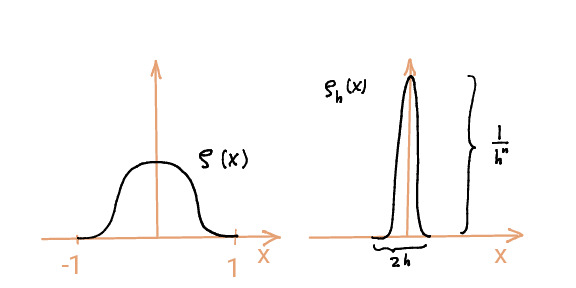
\begin{equation*}
f_h(x) = f\ast \rho_h (x) = \frac{1}{h^n} \int_\Omega \rho\left(\frac{x-y}{h}\right) f(y) dy.
\end{equation*}
Since \(\rho\in C^\infty\text{,}\) we immediately have that
\begin{equation*}
f_h(x) = \frac{1}{h^n} \int_\Omega \rho\left(\frac{x-y}{h}\right) f(y) dy \in C^\infty(\Omega).
\end{equation*}
Furthermore, if \(f\) has compact support, so does \(f_h\text{.}\)
Theorem 3.3.2.
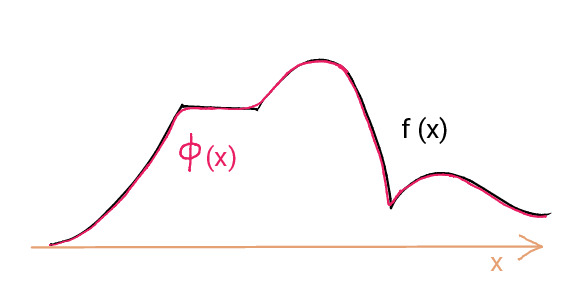
Given \(f\in C_c^0(\Omega)\text{.}\) For each \(\ep>0\) there exists a \(\phi\in C^\infty_c(\Omega) \) such that
\begin{equation*}
\|f-\phi\|_\infty \leq \ep.
\end{equation*}
Proof.
\begin{align*}
|f_h(x) - f(x) | \amp=\amp \left|\frac{1}{h^n} \int_\Omega \rho\left(\frac{x-y}{h}\right) (f(y)- f(x)) dy \right|\\
\amp\leq \amp \sup_{|x-y|\leq h} |f(y) - f(x) | \left|\frac{1}{h^n} \int \rho\left(\frac{x-y}{h}\right) dy \right|.
\end{align*}
Since \(f\) is continuous, we can make \(h\) small such that \(|f(y)-f(x)|<\ep\) for all \(|x-y|<h\text{,}\) and then let \(h\) go to zero.