Section 9.3 The Infinitesimal Generator
The infinitesimal generator arises if we have a semigroup and we would like to know what the corresponding operator is, i.e. we know \(e^{At}\) and want to determine \(A\text{.}\) If the operator exponential exists, we can formally compute
\begin{equation*}
\frac{d}{dt} e^{At} \Big|_{t=0} = A.
\end{equation*}
We do the same in the general case: Definition 9.3.1.
Let \(\{T(t)\}\) be a strongly continuous semigroup. The infinitesimal generator is defined as
\begin{equation*}
Ax = \lim_{h\to 0^+} \frac{T(h) x - x }{h}.
\end{equation*}
The domain \(D(A)\) is the set of all \(x\in X\) where the above limit exists.Example 9.3.2.
\begin{equation*}
Au = \lim_{h\to 0^+} \frac{T(h) u(x) - u(x) }{h} = \lim_{h\to 0^+} \frac{u(x+h)-u(x)}{h} = \frac{\partial}{\partial x} u .
\end{equation*}
Hence the generator is \(A=\frac{\partial}{\partial x}\) with domain \(D(A)=C^1(\RR)\text{.}\)Theorem 9.3.3.
Let \(\{T(t)\}\) be a strongly continuous semigroup on a Banach space \(X\) with infinitesimal generator \(A\text{.}\) Then- For all \(x\in X\) we have\begin{equation*} \lim_{h\to 0} \frac{1}{h}\int_t^{t+h} T(s) x ds = T(t) x . \end{equation*}
- For all \(x\in X\) we have\begin{equation*} \int_0^t T(s) x ds \in D(A), \qquad\mbox{ and }\quad A\left(\int_0^t T(s) x ds \right) = T(t) x-x . \end{equation*}
- For \(x\in D(A)\) we have \(T(t) x\in D(A)\text{.}\) The function \(t\mapsto T(t) x\) is differentiable and\begin{equation*} \frac{d}{dt} T(t) x= A(T(t) x) = T(t) (Ax) . \end{equation*}
- For \(x\in D(A)\) we have\begin{equation*} T(t) x- T(s) x = \int_s^t T(\tau) A x d\tau = \int_s^t A T(\tau) x d\tau. \end{equation*}
Proof.
- First note that since \(T(t)\) is strongly continuous. We find\begin{equation*} \lim_{h\to 0}\left| \frac{1}{h} \int_0^h T(s) x - T(0) x ds\right| \leq \lim_{h\to 0} \frac{1}{h} \int_0^h ds \sup_{s\in[0,h]} \|(T(s) x - T(0) x\| = 0, \end{equation*}hence\begin{equation*} \lim_{h\to 0} \frac{1}{h} \int_0^h (T(s) x - T(0) x) ds =0. \end{equation*}Then, using the semigroup property, we find\begin{equation*} \lim_{h\to 0} \frac{1}{h} \int_t^{t+h} T(s) x ds = \lim_{h\to 0} T(t) \frac{1}{h} \int_0^h T(s) x ds = T(t) \underbrace{T(0)}_{I} x = T(t) x . \end{equation*}
- We compute\begin{gather*} \frac{T(h) - I}{h} \int_0^t T(s) x ds=\\ =\frac{1}{h} \int_0^t (T(s+h) - T(s)) x ds=\\ =\frac{1}{h} \left( \int_0^{t-h} T(s+h) x ds - \int_h^t T(s) x ds + \int_{t-h}^t T(s+h) x ds - \int_0^h T(s) x ds\right)=\\ =\frac{1}{h} \left( \int_h^{t} T(s) x ds - \int_h^t T(s) x ds + \int_{t}^{t+h} T(s) x ds - \int_0^h T(s) x ds\right)=\\ =\frac{1}{h} \int_t^{t+h} T(s) x ds - \frac{1}{h} \int_0^h T(s) x ds=\\ T(t) x - x, \qquad \mbox{for } \quad h\to 0. \end{gather*}
- Writing down the time derivatives gives\begin{equation*} \underbrace{\frac{T(t+h) x- T(t) x}{h}}_{\to \frac{\partial T(t) x}{\partial t}} = \underbrace{\frac{T(h) - I}{h}}_{\to A} T(t) x = T(t) \underbrace{\frac{T(h) - I}{h}}_{\to A}x. \end{equation*}
- Finally, to prove the last relationship, we integrate item 3. and use the Fundamental Theorem of Calculus.
Remark 9.3.4.
Note that the most important part of the Fundamental Theorem is item 3., where the semigroup \(T(t)\) and the generator \(A\) are combined into an abstract differential equation. This is the reason why we develop semigroup theory. Items 1., 2. and 4. then tell us that in this abstract case we can still do differential calculus like we are used to.Theorem 9.3.5.
Let \(A\) be an infinitesimal generator. Then \(D(A)\) is dense in \(X\) and \(A\) is closed.Proof.
\begin{equation*}
x=\lim_{h\to 0} \frac{1}{h}\int_0^h T(s) x ds, \qquad \mbox{and} \quad \int_0^h T(s) x ds\in D(A),
\end{equation*}
hence \(D(A)\) is dense in \(X\text{.}\) To show that \(A\) is closed we consider a convergent sequence \(x_n\in D(A)\text{,}\) \(x_n\to x\) and \(Ax_n\to y\text{.}\) We need to show \(y=Ax\text{.}\) Indeed, from Theorem (Theorem 9.3.3) we know that
\begin{equation*}
T(h) x_n - x_n = \int_0^h T(s) A x_n ds.
\end{equation*}
The first term converges for \(n\to\infty\) to \(T(h) x-x \text{,}\) while the right hand side converges to \(\int_0^h T(s) y ds \text{.}\) Which implies
\begin{equation*}
Ax = \lim_{h\to 0^+} \frac{T(h) x - x }{h} = \lim_{h\to 0} \frac{1}{h}\int_0^h T(s) y ds = y .
\end{equation*}
Remark 9.3.6.
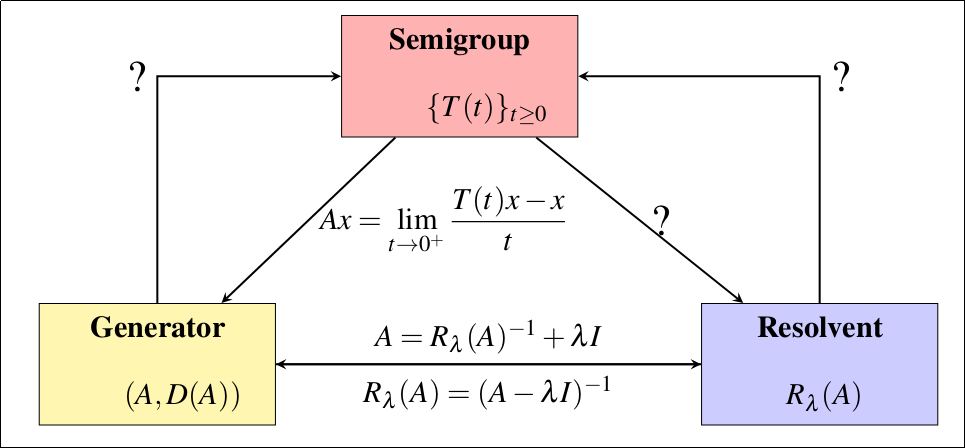
We are starting to build the Semigroup Triangle, which summarizes the relationships between semigroup \(T(t)\text{,}\) generator \(A\) and resolvent \(R_\lambda(A)\text{.}\) It is a tool that helps to visualize the various aspects that are discussed here. As seen in Figure 9.3.7, we identify the relation from \(T\) to \(A\text{,}\) and of course the relations between \(A\) and \(R_\lambda(A)\text{.}\) The question marks are relations that we fill in in the next sections.