Section 4.3 Compact Operators
We know that, in infinite dimension, closed and bounded does not necessarily means compact. For instance, the unit sphere of a Banach space is closed and bounded but it is not compact. The following important class of linear operators are particularly nice from this point of view: loosely speaking, they send bounded sets into compact ones.Definition 4.3.1. Compact linear operators.
An operator \(K:X\rightarrow Y\) between normed spaces is compact if any of the following equivalent conditions is satisfied:- for each bounded set \(U\subset X\text{,}\) \(\overline{K(U)}\) is compact in \(Y\text{;}\)
- for each bounded set \(U\subset X\text{,}\) \(K(U)\) is relatively compact in \(Y\)
- for each bounded sequence \(x_n\in X\text{,}\) the sequence \(Kx_n\) has a subsequence that converges in \(Y\text{.}\)
Proposition 4.3.2.
Every compact operator is bounded.Proof.
\begin{equation*}
\sup_{\|x\|\leq 1} \|K x\|_X \leq M
\end{equation*}
for some \(M>0\text{.}\) Then \(\|K\|_{op}\leq M\) and \(K\) is bounded.Proposition 4.3.3.
If a bounded operator \(A:X\longrightarrow Y\) has finite dimensional range, then \(A\) is compact.Proof.
Lemma 4.3.4.
Let \(\cF(X,Y)\) be the set of all linear maps with a finite-dimensional range from a normed space \(X\) to a Banach space \(Y\text{.}\) Then \(\overline{\cF(X,Y)}^{\|\|_{op}}\subset\cK(X,Y)\text{.}\) Moreover, if \(Y\) is a Hilbert space, then \(\overline{\cF(X,Y)}^{\|\|_{op}}=\cK(X,Y)\text{.}\)Proof.
\begin{align*}
\{ K_1(x_n)\} \amp \text{ has a convergent subsequence } \amp \{K_1(x_{n_{1j}})\},\\
\{K_2(x_{n_{1j}})\} \amp \text{ has a convergent subsequence } \amp \{K_2(x_{n_{2j}})\},\\
\vdots \amp \vdots \amp\vdots\\
\{K_l(x_{n_{(l-1)j}})\} \amp \text{ has a convergent subsequence } \amp \{K_l(x_{n_{lj}})\},\\
\vdots \amp\vdots \amp \vdots
\end{align*}
Consider the diagonal sequence \(y_j=x_{n_{jj}}\text{.}\) Then
\begin{align*}
\|K(y_i)-K(y_j)\|_Y\amp\leq \|K(y_i)-K_n(y_i)\|+\|K_n(y_i)-K_n(y_j)\|+\|K_n(y_j)-K(y_j)\|\\
\amp\leq\frac{\epsilon}{3}+\frac{\epsilon}{3}+\frac{\epsilon}{3}
\end{align*}
for \(n\) and \(i,j\) large enough. So \(\{K(y_n)\}\) is a Cauchy sequence in \(Y\) and it converges, i.e., \(K\) is compact. Now, we assume that \(Y\) is a Hilbert space, we denote by \(e_1,e_2,\dots\) an orthonormal base and set \(P_n(x) = \sum_{i=1}^n\langle x,e_i\rangle e_i.\) Notice that, for every \(y\in Y, \|P_n y\|_Y\leq \|y\|_Y\) and \(P_n(y)\to y\text{.}\) We claim that, given a compact operator \(K\text{,}\) \(\|K-P_nK\|_{op}\to 0\text{.}\) First, denote by \(S_1\) the unit sphere and notice that
\begin{equation*}
\|K-P_nK\|_{op} = \sup_{x\in S_1}\|Kx-P_nKx\|_X=\sup_{y\in K(S_1)}\|y-P_ny\|_Y.
\end{equation*}
Then \(\overline{K(S_1)}\) is compact. Now, let \(\eps>0\text{.}\) Since \(\overline{K(S_1)}\) is compact, there is an \(\eps\)-cover of \(S_1\) consisting in finitely many \(\eps\)-balls centered at points \(y_1,\dots,y_k\text{.}\) Moreover, since there are only finitely many \(\eps\)-balls, there is a \(N>0\) such that \(\|y_{i}-P_n y_{i}\|_Y<\eps\) for all \(n\geq N\) and all \(i=1,\dots,k\text{,}\) Let now \(y\in K(S_1)\) and let \(i_0\) be such that \(d(y,y_{i_0})<\eps\text{.}\) Then
\begin{equation*}
\|y-P_ny\|_Y \leq \|y-y_{i_0}\|_Y + \|y_{i_0}-P_n y_{i_0}\|_Y + \|P_n y_{i_0}-P_ny\|_Y.
\end{equation*}
By construction, \(\|y-y_{i_0}\|_Y<\eps\) and so also \(\|P_n y_{i_0}-P_ny\|_Y<\eps\text{.}\) Moreover, for \(n\geq N\text{,}\) \(\|y_{i_0}-P_n y_{i_0}\|_Y<\eps\text{,}\) so that \(\|y-P_ny\|_Y <3\eps\text{.}\) Hence, \(\|K-P_nK\|_{op}\to0\text{.}\)Theorem 4.3.5.
Let \(X\) be a normed space and \(Y\) a Banach space. Then the set \(\cK(X,Y)\) of all compact operators from \(X\) to \(Y\) is a closed linear subspace of \(\cB(X,Y)\) under \(\|\cdot\|_{op}\text{.}\)Proof.
Corollary 4.3.6.
Let \(\mathcal{K}(X,Y)\) denote the set of linear compact operators from a normed space into a Banach space, then \(\mathcal{K}(X,Y)\) is a Banach space.Example 4.3.7. A non-compact operator.
\begin{equation*}
A=-\frac{d^2}{dx^2}: D(A)\subset L^2([0,1])\to L^2([0,1])
\end{equation*}
is unbounded, hence it is not compact.Example 4.3.8. A compact operator.
\begin{equation*}
Kf(x):=\int_\Omega k(x,y)f(y) dy \quad K:L^2(\Omega)\longrightarrow L^2(\Omega),
\end{equation*}
with \(k\in L^2(\Omega \times \Omega)\) is compact. Indeed, choose \(\{\phi_j\}\) as an orthonormal base (ONB) of \(L^2(\Omega)\text{.}\) Then \(\{\phi_j\phi_i\}\) is ONB of \(L^2(\Omega \times \Omega)\text{.}\) Write
\begin{equation*}
k(x,y)=\sum_{i,j=1}^\infty k_{ij}\phi_i(x) \phi_j(y) \qquad \text{ with }\qquad \|k\|_{L^2(\Omega\times\Omega)}^2=\sum_{i,j=1}^\infty \mid k_{ij}\mid ^2.
\end{equation*}
We consider finite truncations
\begin{equation*}
k_n(x,y):=\sum_{i,j=1}^n k_{ij}\phi_i(x)\phi_j(y),
\end{equation*}
with corresponding intergal operators
\begin{equation*}
K_nu:=\int_{\Omega} k_{n}(x,y)u(y)dy.
\end{equation*}
If \(u=\sum_{l=1}^\infty c_l\phi_l(x),\) then
\begin{align*}
K_nu\amp=\amp\int_\Omega \sum_{i,j,l=1}^{n,n,\infty} k_{ij}\,c_l\,\phi_i(x)\,\phi_j(y)\,\phi_l(y)dy\\
\amp=\amp\sum_{i,j=1}^n k_{ij}\,c_j \,\phi_i(x).
\end{align*}
Hence \(K_n\) has finite dimensional range (rank\(=n\)), which means all operators \(K_n\) are compact. These compact operators approximate \(K\text{:}\)
\begin{equation*}
\|K-K_n\|^2\leq \int_{\Omega}\int_{\Omega}\mid k(x,y)-k_n(x,y)\mid^2dxdy=\sum_{i,j=n+1}^\infty \mid k_{ij}\mid^2\quad \to 0
\end{equation*}
for \(n\to\infty\text{.}\) Hence \(K_n\longrightarrow K\) for \(n\to \infty\) and hence \(K\) is compact as well.Proposition 4.3.9. Compactness and Eigenvalues.
Let \(K\) be a diagonalizable operator on a separable Hilbert space \(H\text{,}\) namely there is a orthonormal basis \(e_1,e_2,\dots\) of \(H\) such that \(K=\sum_{i=1}^\infty \lambda_i e_i\text{.}\) Then \(K\) is compact if and only if \(\lambda_i\to0\text{.}\)Proof.
\begin{equation*}
\|A e_{i_k} - A e_{i_j}\| = \|\lambda_{i_k} e_{i_k} - \lambda_{i_j} e_{i_j}\| \geq \eps\|e_{i_k}-e_{i_j}\|=\frac{\eps}{\sqrt{2}},
\end{equation*}
so \(Ae_i\) does not have converging subsequence, against the hypothesis that \(K\) is compact. Assume now that \(\lambda_i\to0\text{.}\) Then \(K\) is the limit of the sequence \(K_n=\sum_{i=1}^n \lambda_i e_i\text{.}\) Indeed
\begin{equation*}
\|K-K_n\|_{op} = \sup_{\|x\|=1}\|Kx-K_nx\| = \sup_{i>n}|\lambda_i|\to0.
\end{equation*}
Since \(\cK(H,H)\) is closed and \(K_n\in \cK(H,H)\) for all \(n\text{,}\) it follows that \(K\in \cK(H,H)\text{.}\)Corollary 4.3.10. The inverse of an unbounded is compact.
Let \(D\) be a diagonalizable unbounded operator on a Hilbert space whose eigenvalues are away from zero. Then its inverse \(D^{-1}\) is compact.Subsection 4.3.1 Solution of Poisson's equation
We consider the Poisson equation with Dirichlet boundary conditions on the interval \([0,L]\text{:}\)
\begin{equation*}
-f''=g, \qquad f(0)=f(L) = 0, \qquad g\in L^2([0,L])
\end{equation*}
The corresponding differential operator is \(A=-\frac{d^2}{d x^2}\) defined on
\begin{equation*}
D(A) = C^2_0([0,1]) = \{f\in C^2: f(0)=f(L)=0\}.
\end{equation*}
The solution to the Poisson equation is written as
\begin{equation*}
f = A^{-1} g.
\end{equation*}
We claim that \(A^{-1} \) is compact and we prove this fact in two ways. First we show this direclty by explicitly solving the Poisson equation. It is enough integrating twice. First we get that
\begin{equation*}
-f'(y) + f'(0) = \int_0^y g(s) ds.
\end{equation*}
Then we integrate once more:
\begin{equation*}
-f(x) = -f'(0)x + \int_0^x \int_0^y g(s) ds\; dy.
\end{equation*}
By Fubini's theorem (see Figure Figure 4.3.11) we have 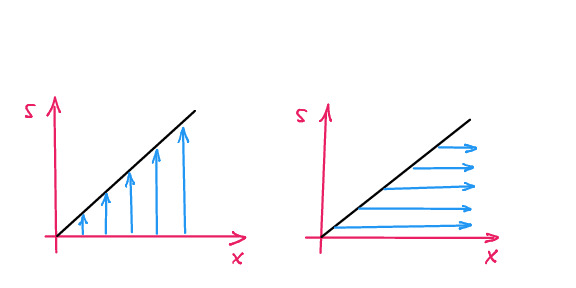
\begin{align}
f(x) \amp=\amp x f'(0) - \int_0^x \int_0^y g(s) ds\; dy\tag{4.3.1}\\
\amp=\amp x f'(0) -\int_0^x\int_s^x g(s) dy\; ds \tag{4.3.2}\\
\amp=\amp x f'(0) -\int_0^x(x-s) g(s) ds \tag{4.3.3}\\
\amp=\amp x f'(0) + \int_0^x (s-x) g(s) ds.\label{e-solutionu}\tag{4.3.4}
\end{align}
From the condition \(f(L)=0\) we get that
\begin{equation*}
0 = L f'(0) + \int_0^L (s-L) g(s) ds,
\end{equation*}
so that
\begin{equation*}
f'(0) = - \frac{1}{L}\int_0^L (s-L) g(s) ds.
\end{equation*}
Then from (4.3.4) we write \(u(x)\) as an integral operator:
\begin{align*}
f(x) \amp=\amp \int_0^x (s-x) f(s) ds - x\frac{1}{L}\int_0^L (s-L) g(s) ds\\
\amp=\amp \int_0^L k(x,s) f(s) ds,
\end{align*}
with integral kernel
\begin{equation*}
k(x,s) =\chi_{[0,x]}(s) (s-x) - x\frac{(s-L)}{L}.
\end{equation*}
Since \(k\in L^2([0,L]^2)\text{,}\) the integral operator is compact. Then
\begin{equation*}
A^{-1} : g \mapsto \int_0^Lk(x,s) g(s) ds,
\end{equation*}
is compact. Now we show the compactness of \(A\) by looking at its eigenvalues. We look for functions \(f\in D(A)\) for which there exists a \(\lambda\in\bC\) such that
\begin{equation*}
-f'' = \lambda f.
\end{equation*}
In order to solve it, we write this second order ODE as a pair of first order ODEs:
\begin{equation*}
f' = g, g' = - \lambda f.
\end{equation*}
This writes matricially as
\begin{equation*}
\begin{pmatrix}f\cr g\cr\end{pmatrix}' = \begin{pmatrix}0\amp 1\cr -\lambda\amp 0\cr\end{pmatrix}\begin{pmatrix}f\cr g\cr\end{pmatrix}.
\end{equation*}
Set
\begin{equation*}
M = \begin{pmatrix}0\amp 1\cr -\lambda\amp 0\cr\end{pmatrix}.
\end{equation*}
Then the solution of the system is given by
\begin{equation*}
\begin{pmatrix}f(x)\cr g(x)\cr\end{pmatrix} = e^{xM}\begin{pmatrix}f_0\cr g_0\cr\end{pmatrix}.
\end{equation*}
Notice that \(M^2 = -\lambda \mathbb{1}_2\text{,}\) so that
\begin{equation*}
M^3 = -\lambda M, M^4 = \lambda^2 \mathbb{1}_2, M^5 = \lambda^2 M, M^6 = - \lambda^3 \mathbb{1}_2,\dots
\end{equation*}
Hence,
\begin{equation*}
e^{xM} = \sum_{n=0}^\infty M^n =
\begin{pmatrix}
1-\frac{\lambda x^2}{2}+\frac{\lambda^2 x^4}{2}+\dots \amp x - \frac{\lambda x^3}{3!} + \frac{\lambda^2 x^5}{5!} +\dots\cr
-\lambda(x - \frac{\lambda x^3}{3!} + \frac{\lambda^2 x^5}{5!}+\dots)\amp 1-\frac{\lambda x^2}{2!}+\frac{\lambda^2 x^4}{4!}+\dots
\end{pmatrix}.
\end{equation*}
For \(\lambda\geq0\text{,}\) we get
\begin{equation*}
e^{xM} =
\begin{pmatrix} \cos(\sqrt{\lambda}x)\amp\frac{\sin(\sqrt{\lambda}x)}{\sqrt{\lambda}}\\ -\sqrt{\lambda}\sin(\sqrt{\lambda}x)\amp\cos(\sqrt{\lambda}x) \end{pmatrix},
\end{equation*}
so that
\begin{equation*}
f(x)=a\cos(\sqrt{\lambda}x) + b\sin(\sqrt{\lambda}x).
\end{equation*}
For \(\lambda\geq0\text{,}\) we get
\begin{equation*}
e^{xM} =
\begin{pmatrix} \cosh(\sqrt{-\lambda}x)\amp\frac{\sinh(\sqrt{-\lambda}x)}{\sqrt{-\lambda}}\\ \sqrt{-\lambda}\sinh(\sqrt{-\lambda}x)\amp\cosh(\sqrt{-\lambda}x) \end{pmatrix},
\end{equation*}
so that
\begin{equation*}
f(x)=a\cosh(\sqrt{-\lambda}x) + b\sinh(\sqrt{-\lambda}x).
\end{equation*}
The Dirichlet boundary conditions are incompatible with the hyperbolic functions and, with the trigonometric functions, imply the following condition:
\begin{equation*}
\lambda = k^2\frac{\pi^2}{L^2}, k=1,2,3,\dots
\end{equation*}
Now, how to verify that the spectrum of \(\overline{A}\) is not larger than the spectrum of \(A\text{?}\) This comes from the following elementary observation. Since \(D(\overline{A})\subset H^2([0,L])\text{,}\) each eigenvector \(f\) of \(A\) is \(H^2\text{.}\) Since, by definition, \(Af=\lambda f\) for some scalar \(\lambda\text{,}\) this means that \(Af\) is \(H^2\) as well. Since \(Af=-f''\text{,}\) this means that \(f\) must be \(H^4\text{.}\) hence \(Af\) is \(H^4\) as well, so \(f\) must be \(H^6\) and so on. Ultimately, this means that \(f\) must be \(H^\infty\text{.}\) As we will see in Chapter 6, \(H^\infty=C^\infty\text{,}\) so every eigenvalue of \(\overline{A}\) must be \(C^\infty\) and so must be an eigenvalue of \(A\) as well. Hence, the spectrum of \(\overline{A}\) is away from zero and its inverse \(\left(\overline{A}\right)^{-1}\) has spectrum \(1,1/2,1/3,\dots\) and so it is compact.