Section 9.5 Flow of an ODE
Let \(X\) be a smooth vector field on a compact manifold \(M\text{,}\) and let \(F^t:M\to M\) denote its flow. For each point \(p\in M\text{,}\) the curve \(t\mapsto F^t(p)\) is the unique solution of the autonomous ODE
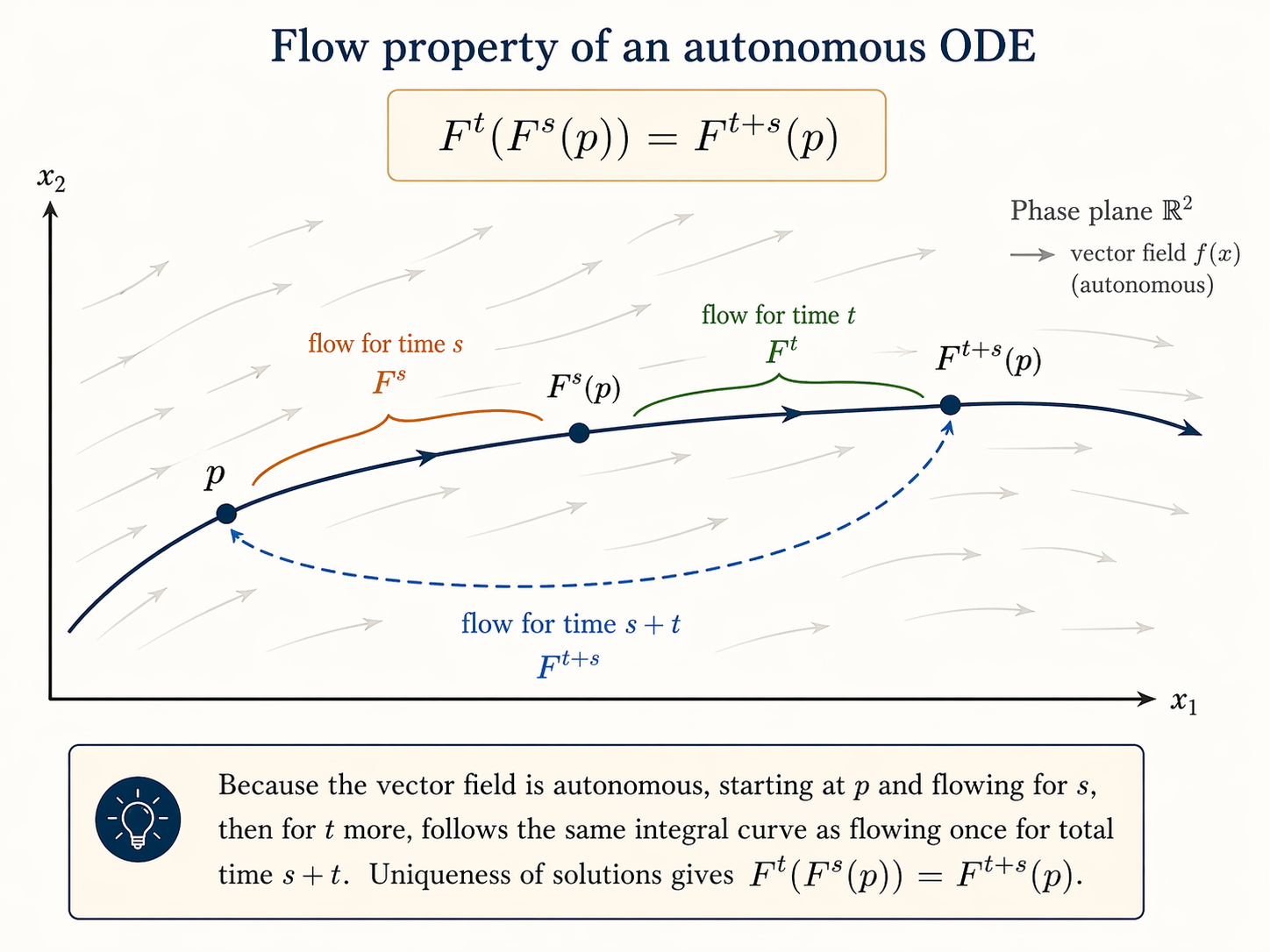
The basic composition law
comes from uniqueness of solutions. Indeed, start at \(p\) and flow for time \(s\text{.}\) This lands at the point \(F^s(p)\text{.}\) From there, flowing for time \(t\) means following the same vector field for \(t\) more units of time. Since the ODE is autonomous, the rule does not depend explicitly on the starting time, only on the current position.
Now compare the two curves
and
Both satisfy the same differential equation
and at \(t=0\) they have the same initial value
By uniqueness of solutions with a given initial condition, the two curves are equal for all \(t\text{.}\) This proves
In words: moving first for time \(s\) and then for time \(t\) is the same as moving once for the total time \(s+t\text{.}\) That is exactly what it means for \(\{F^t\}\) to be a flow.